

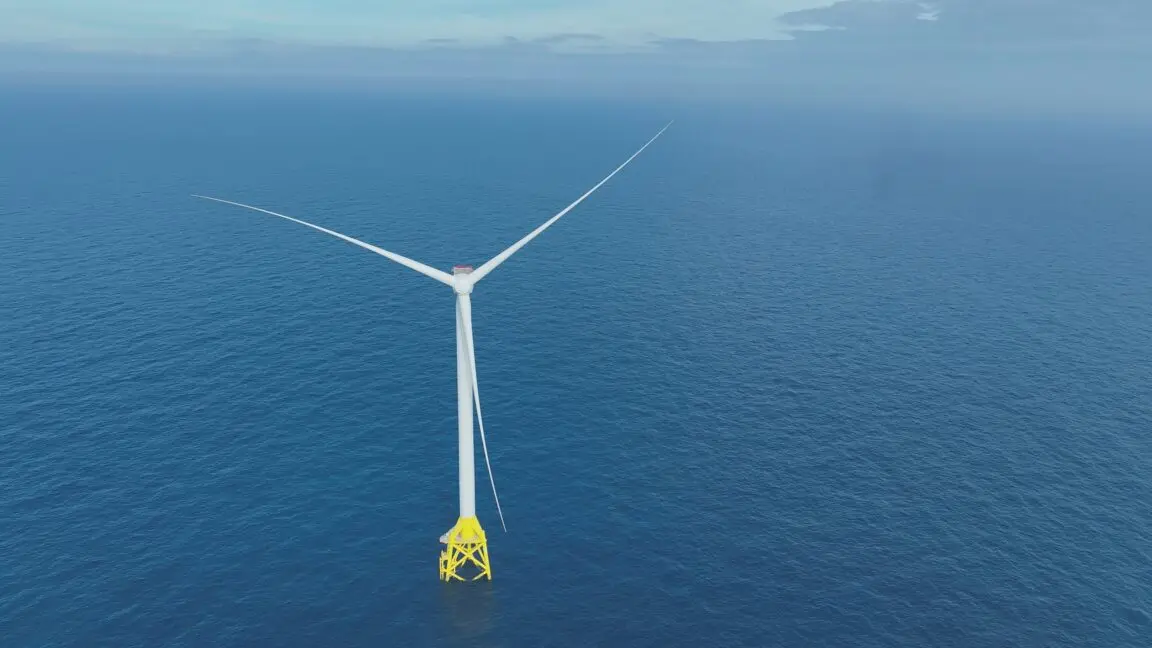
Taiwanese chipmaker TSMC is raking in record profits during the AI boom—but it is also racing to help Taiwan develop wind power and other energy alternatives to fossil fuels amid a global energy crisis. The company, which produces the advanced chips powering artificial intelligence systems worldwide, has signed a landmark 30-year corporate power purchase agreement for 100 percent of the power generated by the Hai Long offshore wind project. This deal, announced on April 30, involves Canada-based Northland Power and covers more than 1 gigawatt of capacity across three offshore wind sites located off the western coast of central Taiwan in the Taiwan Strait.
Once fully completed, the Hai Long offshore wind project will have the capacity to power the equivalent of more than 1 million Taiwanese households. The wind farms within the project began supplying power to Taiwan's grid in 2025 and are scheduled to become fully operational by 2027. This massive renewable energy initiative represents a critical component of TSMC's strategy to secure clean electricity for its rapidly expanding chip fabrication facilities, which are among the most energy-intensive industrial operations in the world.
TSMC's move comes at a time of heightened global energy insecurity. Many countries have scrambled to shore up energy supplies after the war in the Middle East disrupted regional energy production and effectively halted shipping through the Strait of Hormuz. When Qatar shut down natural gas production after its facilities were damaged by Iranian drone strikes in March 2026, Bloomberg reported that Taiwan's power grid lost one-third of its usual supply of liquefied natural gas. That event triggered an energy crunch countdown, because Taiwan relies on natural gas plants to generate about half of its electricity—and Taiwan typically has just two weeks of fuels in reserve. So far, Taiwan's government has managed to stave off energy shortages by tapping alternative natural gas suppliers like Australia and the United States, according to Reuters.
During an energy forum on May 6, Taiwan's vice minister of economic affairs stated that the government had secured enough oil and gas supplies to operate normally through August and possibly September, as reported by Taiwan News. However, the global energy crisis is also spurring the Taiwanese administration of President Lai Ching-te to accelerate efforts to develop fossil fuel alternatives. These efforts include restarting shuttered nuclear power plants and building out renewable power projects. Taiwan relies on imported fossil fuels to meet nearly 97 percent of its overall energy needs—including electricity, transport, and heating—according to the Global Taiwan Institute, a think tank based in Washington, DC.
As part of its energy diversification strategy, Taiwan has pushed to expand offshore wind power. The government has a plan to make 15 gigawatts of capacity available to developers by 2035. This ambitious target aims to reduce the island's heavy dependence on imported natural gas and coal, which are vulnerable to geopolitical disruptions and price volatility. Meanwhile, TSMC has announced its own renewable energy targets: the chipmaker aims for renewable energy to meet 60 percent of its global operations' needs by 2030 and 100 percent by 2040.
TSMC plays an outsize role in shaping Taiwan's energy future, given the enormous energy consumption of its chip fabrication plants, or fabs. According to the International Energy Agency's report on energy and AI, TSMC's energy needs accounted for nearly 10 percent of Taiwan's total electricity consumption in 2023. That share could grow to nearly one-quarter of Taiwan's overall electricity usage by 2030 as TSMC invests in more energy-intensive manufacturing to meet global AI demand for advanced chips. S&P Global estimates, cited by Data Center Dynamics, reinforce this projection, highlighting the skyrocketing power requirements of next-generation semiconductor processes.
The chipmaker's aggressive expansion into wind energy is not new. Beyond the Hai Long project, TSMC previously signed another power purchase agreement with the Danish renewable energy company Ørsted in 2020 for 920 megawatts of power from the Greater Changhua offshore wind farm project, which is expected to become fully operational later in 2026. Additionally, TSMC struck a deal with German renewable energy developer WPD in 2021 to develop more than 1 gigawatt of onshore and offshore wind power. These multiple agreements demonstrate TSMC's commitment to securing long-term renewable energy supplies, even as the company's total electricity demand continues to surge.
The energy crunch in Taiwan underscores a broader global challenge: the intersection of artificial intelligence, semiconductor manufacturing, and national energy security. AI models require vast computing power, which in turn demands enormous amounts of electricity for data centers and chip production. TSMC, as the world's leading contract chipmaker, produces the most advanced processors used in AI training and inference. Its fabs in Taiwan run around the clock, consuming massive amounts of power for lithography, etching, and other fabrication processes. The company's new 3-nanometer and 2-nanometer production lines are even more energy-intensive than previous generations.
Taiwan's vulnerability is exacerbated by its geographic and political situation. The island lies in a seismically active region and is subject to typhoons, which can damage energy infrastructure. Moreover, its isolation from international energy grids means it must rely on sea-borne imports of fossil fuels. The Qatar incident demonstrated how quickly a single disruption could cripple the entire power system. Taiwan's ability to maintain a stable electricity supply is not only an economic concern but a national security one, as a prolonged blackout could halt semiconductor production globally.
To mitigate these risks, Taiwan's government is pursuing a multipronged approach. In addition to offshore wind, it has proposed restarting the mothballed Kuosheng and Maanshan nuclear power plants, which were phased out after the 2011 Fukushima disaster in Japan. Nuclear energy provides baseload power without carbon emissions, but faces strong public opposition in Taiwan. The administration is also investing in solar power, battery storage, and demand-side management programs. However, the scale of TSMC's future energy needs—potentially consuming 25 percent of national electricity—means that even these efforts may be insufficient without further breakthroughs in energy efficiency or new generation capacity.
The Hai Long project itself is a significant engineering endeavor. The three offshore wind sites are located in the Taiwan Strait, an area known for strong winds but also for complex seabed conditions and potential typhoon impacts. Each site will feature multiple turbines, each with capacities exceeding 10 megawatts. The electricity generated will be transmitted via submarine cables to onshore substations before feeding into the national grid. The 30-year PPA with TSMC provides financial certainty for Northland Power to invest in construction and maintenance, while giving TSMC a guaranteed supply of renewable energy certificates to meet its sustainability targets.
Analysts view TSMC's wind power investments as a model for other energy-intensive industries. By committing to long-term contracts, large corporations can de-risk renewable projects and accelerate the transition away from fossil fuels. Yet, the broader lesson from Taiwan's experience is that energy planning must account for rapid technological shifts. The AI boom was largely unforeseen a decade ago, and its electricity demands are reshaping utilities' load forecasts worldwide. Countries hosting major semiconductor foundries, data centers, or AI research hubs will need to scale up clean energy generation at a pace that matches the growth of digital infrastructure.
In the meantime, TSMC continues to expand its manufacturing footprint. The company is building new fabs in Arizona, Japan, and Germany, partly to diversify its geographic risk. Each of these new facilities will also require substantial amounts of electricity, and TSMC is expected to replicate its renewable energy procurement strategy in those regions. The company's global energy demand could therefore become an even larger driver of renewable energy development worldwide. For now, the Hai Long project stands as a tangible example of how corporate ambition can help solve energy challenges—even as those challenges grow more urgent.
Source: Ars Technica News