

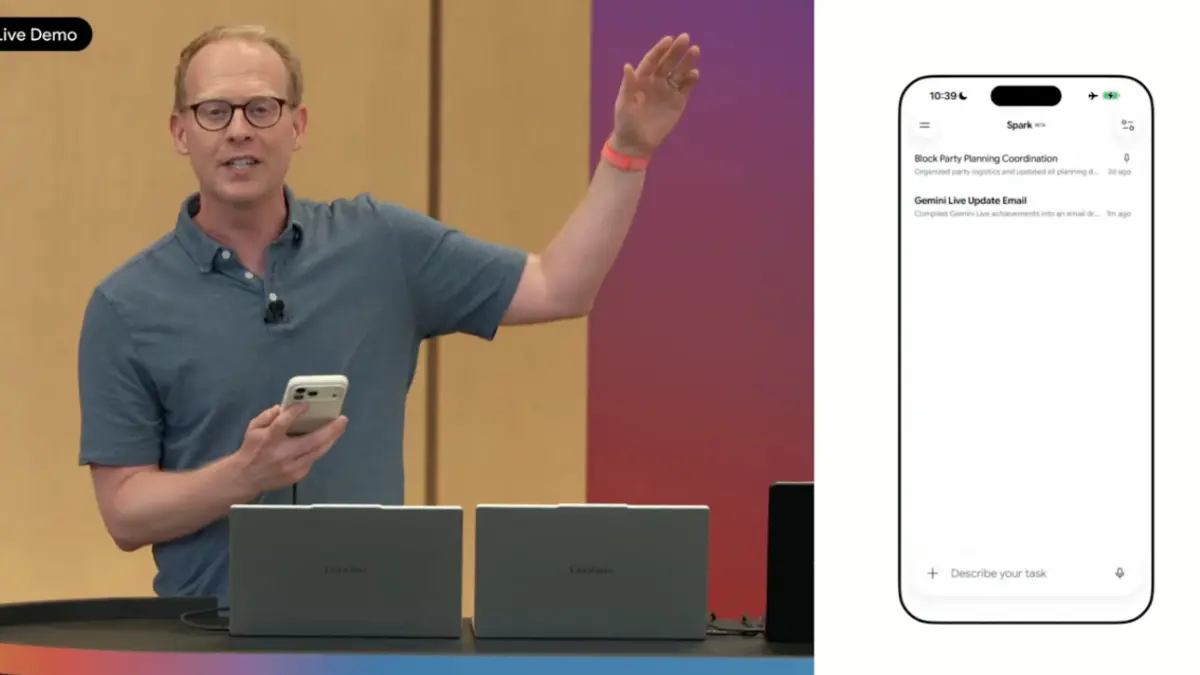
OpenClaw started a mini-revolution in the AI world by demonstrating what was possible with AI agents. At Google I/O 2026, the company finally unveiled its own answer: Gemini Spark, a personal AI agent designed to harness the power of Gemini intelligence while tapping into users' personal files.
During the keynote, Google CEO Sundar Pichai announced that a beta version of Gemini Spark would soon be available to Google AI Ultra subscribers, the company's premium AI subscription plan. Spark will run on the newly announced Gemini 3.5 Flash model, ensuring fast and efficient performance. While OpenClaw has become hugely popular among AI enthusiasts and early adopters, Google's massive reach—billions of users across its products, with the Gemini app alone boasting 900 million monthly active users—could propel agentic AI into the mainstream for the first time. Here's why Gemini Spark may have an edge over tools like OpenClaw.
Gemini Spark is a cloud-based AI agent
Famously, OpenClaw runs on a local device such as a Mac Mini. Shortly after the tool went viral (first as Clawdbot, then Moltbot), Mac Minis quickly sold out at Amazon and other retailers. This hardware dependency creates a barrier for many potential users who may not want to invest in a dedicated machine or deal with complex installation processes. Gemini Spark, by contrast, is a fully cloud-based AI agent. That makes it far more beginner-friendly – there's no hardware to buy, no software to configure, and no need for technical expertise to get started. And when you close your laptop, Spark keeps working in the background, accessible from any device with an internet connection.
This cloud-native architecture also means that Google can scale operations effortlessly. Updates, security patches, and new features can be rolled out centrally without requiring users to download anything. For enterprises and individual users alike, this reduces maintenance overhead and ensures that everyone runs the latest version. Moreover, because Spark operates in the cloud, it can leverage Google's vast server infrastructure to handle complex tasks that might overwhelm a local machine. Users can submit requests involving large datasets, real-time web searches, or multi-step workflows without worrying about processor limitations or battery drain.
Gemini Spark will be able to run 24/7 in the background, performing tasks like monitoring email, managing schedules, or even conducting research while you work on other projects. This persistent availability is a key advantage over local agents that must be left running on a dedicated device, consuming energy and resources. With Spark, the heavy lifting happens in Google's data centers, freeing up users' local hardware for other activities.
Gemini Spark will have better access to your data
Second, if you're already a Google user—which billions of people are—then Gemini Spark will have native access to your Gmail, Google Docs, Google Drive, Google Calendar, and more. This integration goes far beyond what OpenClaw can achieve without extensive manual configuration. For instance, if you ask Gemini Spark to plan a company event, it can automatically pull contacts from Gmail, find relevant documents and artwork from Google Drive, check your schedule for available dates in Google Calendar, and even draft invitations using Docs. It can then send those invitations through Gmail, all within a single seamless workflow.
OpenClaw can accomplish similar tasks if granted API access to each service, but that requires users to navigate OAuth permissions, manage tokens, and often rely on third-party plugins or custom scripts. Gemini Spark eliminates these friction points because Google's ecosystem is already fully integrated. The agent understands the structure of your emails, files, and calendar entries without needing additional setup. This pre-built compatibility dramatically reduces the time to first useful interaction.
Moreover, Gemini Spark will be built into Google Chrome and will work across desktop, Android, and iOS devices. This cross-platform presence means you can start a task on your laptop and continue it on your phone without missing a beat. OpenClaw, while powerful, is primarily designed for desktop use and doesn't offer the same level of mobile integration. For users who rely on their smartphones for day-to-day tasks, Spark's ubiquity is a significant advantage.
Google also demonstrated a feature called "Agent Sync," which allows Spark to persist its state across sessions. If you ask it to research a topic and then close your browser, Spark continues working in the cloud and presents a summary when you return. This resembles a personal assistant that never sleeps, and it's made possible by the cloud infrastructure.
Cybersecurity peace of mind
OpenClaw has a DIY ethos, and because it grants users deep control over their hardware, it presents significant cybersecurity challenges. Early versions of OpenClaw (then known as Clawdbot) were exploited by malicious actors who used the agent's capabilities to perform unauthorized actions on users' systems. Some of those problems have since been addressed now that OpenClaw is part of Anthropic, but the underlying risk remains: local agents have direct access to the operating system, and any vulnerability can be catastrophic.
Gemini Spark, by operating in Google's cloud, benefits from the company's world-class cybersecurity infrastructure. Google employs thousands of security engineers, uses advanced threat detection algorithms, and complies with stringent industry standards like SOC 2 and ISO 27001. User data is encrypted at rest and in transit, and access controls are rigorously enforced. For billions of users who already trust Google with their emails, private documents, and photos, extending that trust to an AI agent feels natural.
In addition to security, Google is introducing a novel safeguard called the Agent Payments Protocol (AP2). This protocol is designed to prevent AI agents from overspending users' money. Users will be able to set strict limits on how much Spark can spend, which merchants it can use, and what types of purchases it can make. For example, you could allow Spark to buy office supplies up to $200 from approved vendors, but block any transaction over that amount or with an unlisted merchant. AP2 ensures that even if the agent misinterprets a request, it cannot go rogue and drain your bank account.
Google is introducing Gemini Spark slowly, starting with a beta for AI Ultra subscribers. This phased rollout allows Google to test Spark with power users—people who understand the technology and can provide feedback—before launching it to everyday users. By taking this cautious approach, Google aims to iron out bugs, improve usability, and build trust. OpenClaw's rapid viral spread led to some user frustration as the tool struggled to keep up with demand and security issues. Google's measured strategy could avoid those growing pains.
Another cybersecurity advantage is transparency. Google plans to publish audit logs for every action Spark takes, so users can review what the agent did and why. This audit trail makes it easy to identify mistakes or malicious behavior. OpenClaw offers some logging but not with the same depth or user-friendly interface.
The combination of cloud-based operation, native data access, and robust cybersecurity measures gives Gemini Spark a compelling edge over OpenClaw for the mass market. While OpenClaw remains a favorite among tinkerers and developers who value full control, Gemini Spark is built for the billions of people who just want things done without headaches. By lowering the barrier to entry, eliminating hardware requirements, and leveraging existing user trust, Google's Gemini Spark could indeed be the first AI agent used by countless internet users who have never heard of OpenClaw.
Google's announcement also highlighted partnerships with major app developers. Spark will integrate with third-party services like Uber, DoorDash, and Spotify through a new "Agent Extensions" framework. This means you could ask Spark to order your usual coffee while scheduling a meeting, and it will coordinate across apps without needing separate integrations. OpenClaw's community has built similar connectors, but they often require manual updates and may break when APIs change. Google's platform approach ensures reliability and consistency.
As the beta rolls out, initial feedback from AI Ultra subscribers will be critical. Google is known for iterating based on user input, and Spark's eventual public release could be significantly refined. The company has also hinted at a free tier with limited usage, similar to how Gemini offers free access to its chat interface. If Google follows that model, Gemini Spark could become the default AI agent for millions of users who would never pay for a premium subscription.
In summary, Gemini Spark differentiates itself from OpenClaw in three fundamental ways: it operates entirely in the cloud, offering persistence and cross-device access; it has native, seamless integration with Google's vast ecosystem of services; and it provides enterprise-grade security and financial safeguards through the Agent Payments Protocol. These advantages, combined with Google's massive user base and trusted brand, position Gemini Spark to bring agentic AI into the mainstream. While OpenClaw will continue to serve niche power users, Spark is designed for everyone else.
Source: Mashable News