

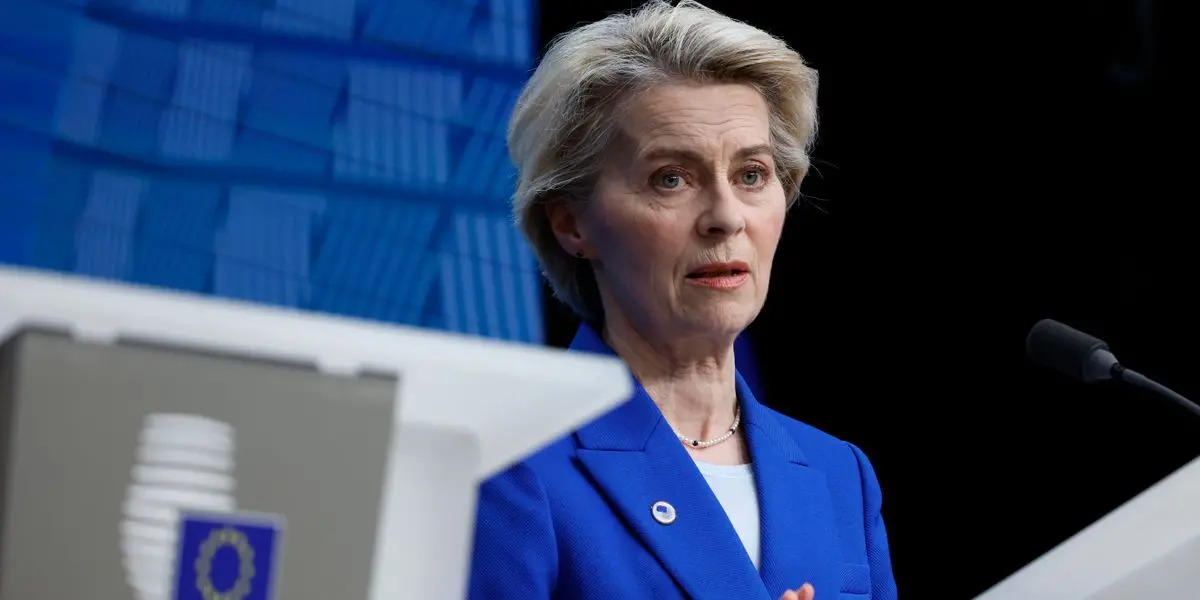
European Commission President Ursula von der Leyen has been forced to cancel all external engagements scheduled for the first two weeks of January 2026 after being diagnosed with a severe lung infection, according to a statement released by her spokesperson on Thursday. The German politician, who has led the European Union's executive arm since December 2019, is currently recovering at her home in Hannover, Germany, where she continues to carry out her official duties remotely.
"The President has cancelled her external appointments for the first two weeks of January. She is suffering from a severe pneumonia," a Commission spokesperson confirmed in response to queries from the German Press Agency (dpa). The Polish Press Agency (PAP) likewise reported on her illness. Von der Leyen's condition is serious enough to prevent her from attending high-profile events, including the ceremonial launch of Poland's rotating presidency of the Council of the European Union, which officially began on January 1, 2026.
Missed Poland Trip and Diplomatic Context
Originally, von der Leyen was scheduled to travel to Gdańsk on Friday to mark the beginning of Poland's six-month tenure at the helm of EU intergovernmental negotiations. The visit was considered symbolically significant because Poland, under Prime Minister Donald Tusk's pro-European government, is expected to steer the EU through a period of internal challenges and geopolitical pressures. The ceremony in Gdańsk will proceed without the Commission President; a rescheduled visit will be arranged at a later date, her office confirmed.
The cancellation comes at a sensitive moment in EU diplomacy. Earlier this week, Poland's government decided to disinvite the Hungarian ambassador from the Gdańsk ceremony, following a long-standing dispute over political asylum. Hungary had granted asylum to a former Polish deputy minister convicted of corruption, sparking a diplomatic row between Warsaw and Budapest. Von der Leyen, who has often mediated between eastern and western EU member states, had been expected to use her presence in Gdańsk to reaffirm the bloc's unity. Her absence may allow the focus to remain on the bilateral tensions rather than on forward-looking presidential priorities.
Recovery and Work Arrangements
According to the Commission spokesperson, von der Leyen is managing her agenda from Hannover, where she receives medical care and is in close contact with her cabinet. "If all goes well, the President will be fully recovered by the middle of the month. She will then resume work from her office in the Commission's Berlaymont building in Brussels," the spokesperson said. The prognosis suggests a period of several weeks of convalescence, but her office stressed that there is no risk of a prolonged incapacitation.
Von der Leyen, 67, has a history of health-related disruptions during her tenure. In 2024, she contracted a mild case of COVID-19 that forced her to work remotely for a week. More seriously, in 2023 she underwent surgery for a sciatic nerve problem, which sidelined her for nearly a month. Colleagues describe her as a resilient leader who does not easily allow personal health to interfere with her duties. However, the Commission has implemented contingency plans to ensure continuity: Executive Vice-President Margrethe Vestager will represent the Commission at the Polish presidency handover events, while other vice-presidents will cover key meetings on digital policy and climate legislation scheduled for mid-January.
Background: Von der Leyen's Role and Leadership
Ursula Gertrud von der Leyen, born in 1958 in Brussels to a European civil servant father, has been a towering figure in European politics for over two decades. A medical doctor by training, she served as Germany's Federal Minister of Defence from 2013 to 2019, before being nominated as the first woman to head the European Commission. During her first term (2019–2024), she oversaw the EU's unprecedented response to the COVID-19 pandemic, including the joint vaccine procurement program, and led the bloc's sanctions against Russia following the invasion of Ukraine. She was narrowly confirmed for a second term in 2024 after a tense vote in the European Parliament, with her narrowly winning majority support from center-right, liberal, and some socialist MEPs.
Her second Commission, which took office in December 2024, is tasked with implementing the European Green Deal, advancing digital transformation, strengthening EU defence cooperation, and managing the bloc's enlargement process amid ongoing negotiations with Ukraine, Moldova, and the Western Balkans. Von der Leyen's leadership style has often been described as both decisive and diplomatic, though she has drawn criticism from some member states for concentrating too much power in the Commission presidency. Her current illness temporarily removes a key player from the Brussels decision-making circuit at a time when the Polish presidency is expected to push forward dossiers on migration reform, security policy, and the next Multiannual Financial Framework.
Poland's EU Council Presidency: Priorities and Challenges
Poland assumed the rotating chair of the Council of the EU for the first time since 2011, this time under a government led by Donald Tusk's Civic Coalition. The previous Law and Justice (PiS)-led administration held the presidency in 2011, but the current pro-European orientation marks a shift. Warsaw's stated priorities include strengthening European defence and security in the face of the war in Ukraine, enhancing energy independence from Russian fossil fuels, and promoting the competitiveness of European industry. The presidency also intends to advance the EU's migration and asylum pact, which was finalized in 2024 but still requires detailed implementation regulations.
However, the presidency is already overshadowed by the diplomatic spat with Hungary. The decision to uninvite Budapest's ambassador from the opening ceremony stems from Hungary's grant of political asylum to Marcin Romanowski, a former Polish deputy justice minister who was under investigation for alleged misuse of public funds. Poland considered that a violation of mutual trust among EU members and reacted by barring Hungarian officials from the presidency launch events. The Commission has publicly called for de-escalation but has not taken a firm position. Von der Leyen's absence means that no top Commission figure will be on site to facilitate a back-channel resolution, though EU diplomats expect the issue to be handled through quiet diplomacy in Brussels.
Broader Implications of Von der Leyen's Illness
While the Commission has assured that all policy work continues unaffected, the President's temporary withdrawal from in-person meetings could slow down certain high-level negotiations. Key legislative pushes, such as the final adoption of the EU's cyber resilience act and the revision of the bloc's fiscal rules, are scheduled for the coming weeks. Von der Leyen's authority and personal involvement have often been crucial in brokering compromises between member states and the European Parliament. In her absence, the Commission's College of Commissioners will operate on a daily management basis, with crisis decisions requiring teleconferences and written procedures.
Health experts note that pneumonia in older adults can be serious and may require several weeks of full recovery. The Commission is providing regular updates but has refrained from specifying the exact treatment von der Leyen is receiving. A spokesman emphasized that she remains fully informed and is taking all decisions in consultation with her chief of staff, Bjoern Seibert. The fact that she is working from Hannover, rather than a hospital, suggests that her condition is stable but still requires rest.
Observers point out that the timing of her illness coincides with a period when the EU is facing multiple crises: the ongoing war in Ukraine, rising energy prices, economic slowdown in Germany, and populist challenges in several member states. The Polish presidency was seen as an opportunity to inject fresh momentum, especially regarding enlargement and security. Von der Leyen's absence is unlikely to derail these efforts, but it reduces the Commission's direct visibility during the crucial early weeks of the presidency.
Outlook
The Commission expects von der Leyen to resume full duties by mid-January 2026, just in time for the first European Council summit of the year, scheduled for late January. That summit is expected to address top priorities: a review of military aid to Ukraine, progress on the EU's next long-term budget, and the future of EU-Hungary relations. By then, the President is anticipated to have regained her strength and be ready to steer the Commission through another demanding year. Until then, her absence will be keenly felt on the Brussels stage, but the machinery of the European Union is designed to weather even the unexpected absence of its highest-profile figure.
Source: Spiegel News