

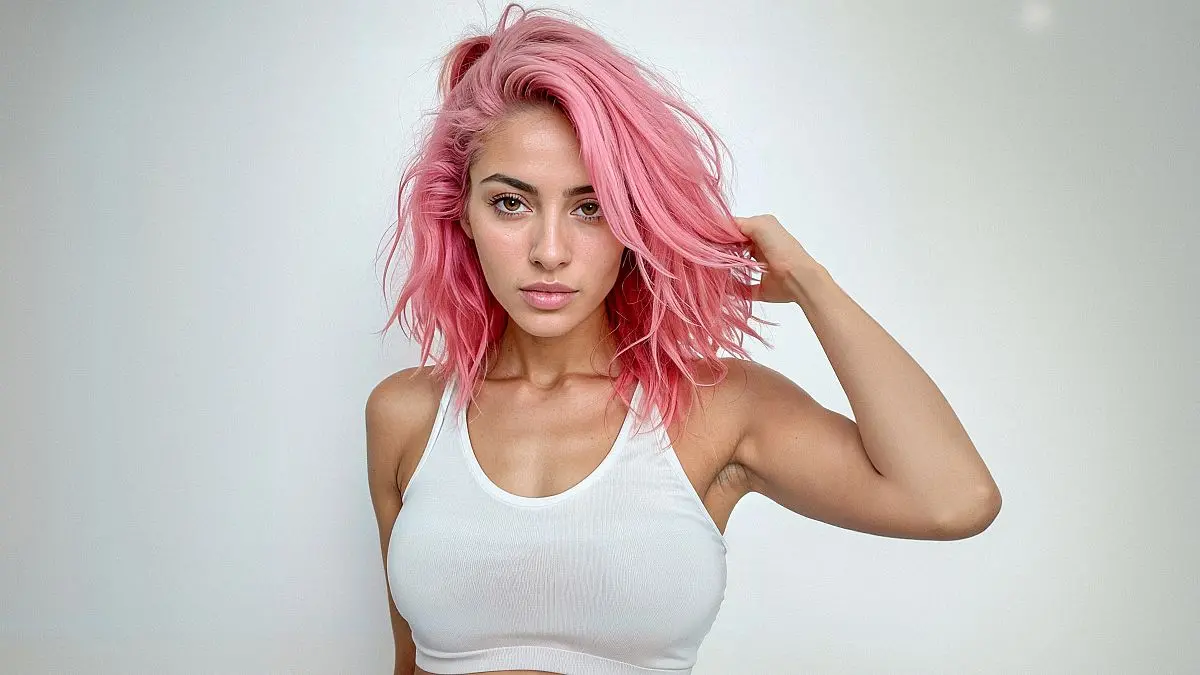
Aitana, the first Spanish AI model, was born out of necessity. Last summer, her creator Rubén Cruz, founder of the agency The Clueless, faced a difficult period with few clients. "We began to analyze how we worked and realized that many projects were put on hold or canceled due to problems beyond our control. Often it was because of the influencers or models, not the design," Cruz explained to Euronews. So the agency decided to create its own influencer to use as a model for brand assignments.
Thus Aitana emerged: a carefree, flawless 25-year-old woman with pink hair from Barcelona. The virtual model now earns up to €10,000 per month, with an average of €3,000, according to her creator. "We did this to make a better living and not be dependent on other people who have an ego, are crazy, or just want to make a lot of money posing," Cruz said.
Aitana's income is quite irregular. For a sponsored post, she earns around €1,000. She recently became the face of Big, a sports supplement company. On Fanvue, she also uploads photos of herself in lingerie. The platform works similarly to OnlyFans, where users pay a monthly subscription to view the images. In just a few months, she has amassed over 120,000 followers on Instagram. Thousands of people see her photos and react to them. She even receives private messages from celebrities who do not know that Aitana is not a real person. "One day, a famous Latin American actor sent a message asking her for a date. This actor has about 5 million followers, and some of our team watched his TV series as children," Cruz said. "He had no idea that Aitana didn't exist."
How to bring an AI to life
Every week, the agency team meets to shape Aitana's life. They decide what she will do during the week, which places she will visit, and what photos will be uploaded to feed followers with content. No actual photo shoots are held. Supported by artificial intelligence, the agency's design experts ensure that the model can, for example, spend a weekend in Madrid. "In the first month, we realized that people follow for the life, not for the images. Since she is not alive, we had to give her a bit of reality so that people could build a relationship with her. We had to tell a story," said graphic designer Cruz.
Unlike traditional models, whose personalities are usually not revealed so they can be a "blank canvas" for designers, Aitana has a "very own personality," he explained. She was designed as a determined fitness enthusiast with a complex character. On her website, she describes herself as open-minded and caring. "We thought a lot about Aitana. We created her based on what society likes most. We considered preferences, hobbies, and niches that have been trending in recent years," Cruz said. After analyzing trends, they found that Eastern culture has strongly oriented towards Europe in recent years. They tried to incorporate this by giving Aitana pink hair and a weakness for video games.
Aitana was such a success that her designers have already created a second virtual model named Maia, who is "a bit more shy." The names were also chosen intentionally: both contain the English abbreviation for artificial intelligence (AI).
Criticism of using AI models
The agency is flooded with requests from brands wanting their own personalized models. "They want an image that is not a real person and that represents their brand values, so that there are no continuity issues if they need to let someone go or can no longer count on them," Cruz said. AI models are also relatively cost-effective. Cruz described the earnings of real top influencers as "abnormal." "Kim Kardashian earns a million euros for an Instagram photo, and she doesn't cure cancer. No one deserves a million euros for uploading a photo to a social network; that seems absurd to me," he said.
The agency believes that AI models could help lower prices in the market and give small agencies that cannot afford large advertising campaigns a boost. However, the practice is not without controversy. Critics fear that the unrealistic perfection of the models could tempt especially younger followers to emulate that perfection. The highly sexualized portrayal of AI models is also criticized. Not only on her Fanvue account is Aitana seen in lingerie, but also on her Instagram account there are numerous such images. The agency responds to the criticism by saying that they are simply following the aesthetic already created by real influencers and brands. "If we don't follow this aesthetic, brands won't be interested. To change this system, you have to change the vision of the brands. The world in general is sexualized," Cruz said.
Background on virtual influencers
The rise of AI influencers is not unique to Spain. Globally, virtual models like Lil Miquela, a computer-generated character with millions of followers, have been collaborating with fashion brands and appearing in campaigns. These digital creations blur the line between reality and fiction, raising questions about authenticity, consumer trust, and the future of influencer marketing. Aitana's success highlights a growing trend where agencies and brands seek greater control over their marketing assets. By owning a virtual model, companies avoid the unpredictability of human influencers, such as scandals, contract disputes, or personality clashes. The technology also allows for rapid content generation and brand integration.
From a technical perspective, creating an AI model involves a combination of 3D modeling, machine learning, and image generation. The Clueless agency uses AI tools to generate realistic faces, adjust expressions, and simulate environments. The process is iterative, requiring careful manual refinement to achieve the desired aesthetic. Cruz notes that the team spends hours discussing Aitana's backstory, likes, and dislikes to make her relatable. "We give her a personality that resonates with our target audience," he adds. The data shows that followers engage more with content that tells a story rather than just displaying a product.
The economic implications are significant. While top human influencers may charge tens of thousands of euros per post, AI models can offer competitive rates while maintaining constant availability. This democratizes access to influencer marketing for smaller businesses. However, the ethical concerns remain. The over-sexualization of AI models and the pressure on young people to achieve unattainable beauty standards are real issues. Regulators in some countries are beginning to look into labeling requirements for AI-generated content. In Europe, the EU's Digital Services Act may impose transparency rules on platforms hosting virtual influencers. Aitana's creators are aware of these challenges but argue that they are simply following market demand.
As the technology evolves, we can expect more sophisticated AI models that can interact in real-time, respond to comments, and even adapt their personalities based on user feedback. The line between human and machine may become even more blurred. For now, Aitana remains a pioneering figure in Spain's digital landscape, earning a substantial income and proving that virtual influencers are here to stay.
Source: euronews News