

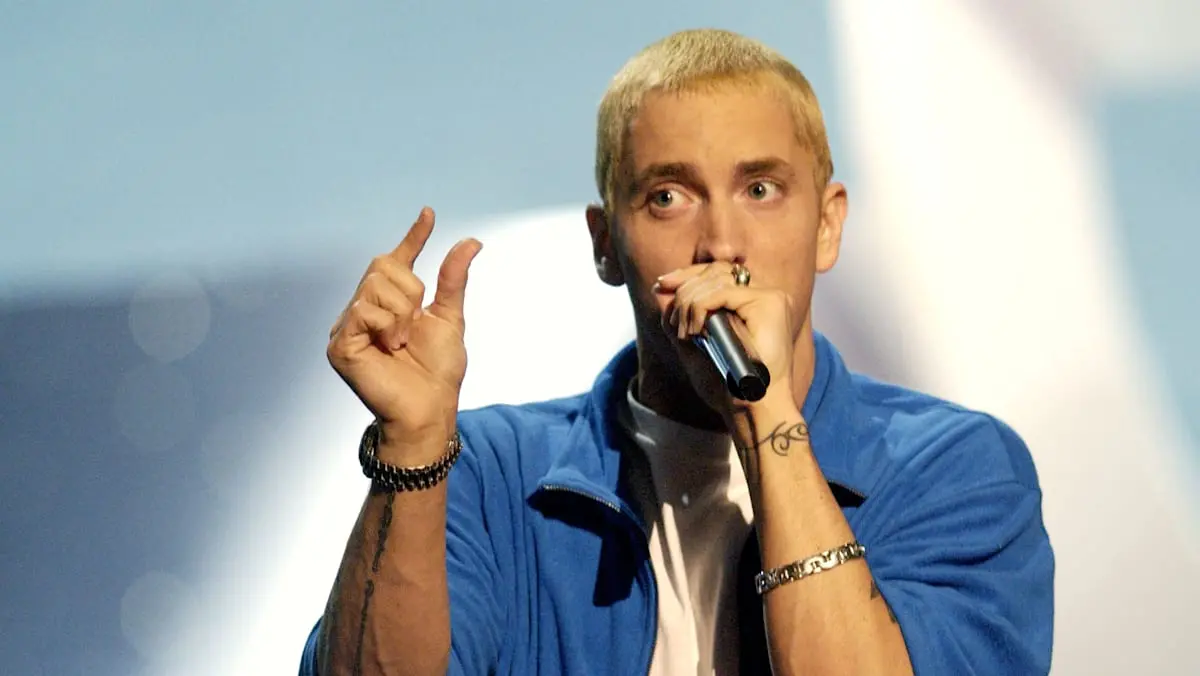
There is an iconic image from 2001 that tells a great deal about what people thought of Eminem at that time. In blue overalls, a hockey mask, and wielding a chainsaw on stage, he stood as a self-styled serial killer hybrid, conjuring pop culture figures like Jason Voorhees, Chucky, and Leatherface. That image encapsulates the provocative persona that made him one of the most controversial entertainers of the early 2000s.
Now, in 2021, that image is back in discussion thanks to a new book that asks whether art must respect social boundaries. Written by Antonia Baum, the book is part of the KiWi music library series, where authors reflect on musicians who shaped them. Baum, one of the most gifted writers in Germany, turns her attention to Eminem, the self-proclaimed greatest rapper alive. What should have been a straightforward musical biography becomes a deeper exploration of her own struggle with a love-hate relationship.
Love-Hate with Misogynistic Lyrics
Baum does not hide her conflict. She describes how Eminem's music accompanied her for much of her life, yet she now finds his lyrics indefensible from a feminist perspective. She points to lines that are misogynistic, homophobic, violent, and degrading. In a previous essay for a major German weekly, she argued that it was time to distance herself from German rap and its misogynistic texts. Now she applies the same critical lens to Eminem.
The central question of her book is not just about Eminem himself but about the boundaries of art. Is it permissible to enjoy or defend music that contains morally problematic content? Can an artist invent a persona that says horrific things without being held personally accountable for those words? Baum raises these questions with nuance, acknowledging that there are no easy answers.
The Authenticity Debate in Rap
Why does this debate keep resurfacing, especially in hip-hop? The answer lies in the genre's long-standing emphasis on authenticity. Rap fans and critics have traditionally expected the lyrics to reflect the artist's real life and experiences. The gap between the lyrical 'I' and the private person is supposed to be as small as possible, or even nonexistent. This expectation has been reinforced by rap artists themselves, who often sell authenticity as their greatest value.
However, this notion is largely nonsense. Since at least the 2010s, image-based rap has been an accepted genre practice. A prime example is American superstar Rick Ross, who spent years presenting himself as a global drug dealer and gangster boss. When it emerged that he had previously worked as a prison guard, it did not harm his career. Record sales remained strong, and fans continued to stream songs where he maintained the illusion of a sprawling criminal empire.
Most hip-hop listeners understand that this is an auditory action film, not reality. The exaggeration and shock value serve the purpose of entertainment. The problem, as the article notes, lies with those who observe hip-hop only superficially. Antonia Baum is not one of them. She knows the codes and functions of the genre. Instead, she belongs to a new generation of authors and music journalists who demand that the moral standards applied to society also be reflected in art.
The Unassailable Consensus of Our Culture
Here lies the core problem. Marshall Mathers is not Eminem. The artist created a fictional persona that allows him to explore extreme scenarios: murdering his wife, raping his mother, or running through a school with a gun. However, this persona is not meant to be taken at face value. Eminem is a fictional character, and within the logic of art, different rules apply than to the private person. This principle is an unassailable consensus of our culture.
One can illustrate this with cinema: no one seriously criticizes Joaquin Phoenix for playing the Joker, nor would anyone accuse an actor of being a ruthless jerk because they play Richard III at the Berlin Schaubühne. The ability to separate the artist from the work is fundamental. Yet, this separation is increasingly being questioned, particularly in music, and especially with regard to hip-hop.
Baum acknowledges this argument and describes it as a conflict between 'young vs. old, woke Twitter people versus old white men' who want to preserve the privilege of worshipping the artist while ignoring problematic lyrics. But she does not dismiss it; she understands the complexity. The question of whether to separate artist and work is not a fashion issue; it defines the very understanding of art and society.
The Function of Art: Provocation and Boundaries
Art should not conform to the mainstream but challenge it, expose its double standards and hypocrisy. Culture must not be affirmation; it must be a challenge, an imposition. Art must trigger debates and controversies. It does so by not following rules, by speaking the unspeakable, by transcending boundaries and illustrating misogyny without necessarily being misogynistic itself.
This is not about provocation for its own sake but for the sake of discourse. Eminem certainly provokes discourse when he raps from the perspective of a school shooter at a time when the United States was dealing with a string of tragic school massacres. His art creates a perspective that can only be represented in artistic form, a perspective that helps make reality more understandable.
Historical Parallels and the Evolution of Outrage
The debate about the limits of art is not new. A look back at recent pop culture history shows how these battles have repeatedly erupted. In the 1970s, hard rock and glam rock challenged sexual norms. David Bowie's blurring of gender lines, Kiss's hedonism, and Black Sabbath's dark hymns about working-class alienation provoked clergy and society.
In the 1980s, splatter films broke all taboos of visual convention. Today, George A. Romero's zombie films are recognized by intelligent critics as exaggerated, blood-drenched critiques of consumer society. In the 1990s, the violent video game debate raged, yet today, games like Doom receive recognition in highbrow arts sections. In the 2000s, artists like Marilyn Manson and rap music became the new bogeymen.
Today, the debate has shifted from individual products or genres to a wholesale reassessment of art. Art is no longer granted its own space; artists are constantly pulled into the socio-political present. They are expected to integrate the mainstream consensus into their work rather than contradict it. This shift is dangerous, especially when it comes from the same left-wing quarter that once fought for freedom of expression in art and hip-hop.
Cancel Culture and the Blurring of Real and Fictional
The discourse surrounding 'cancel culture' has been skewed because it often fails to address the status of art as its foundation. Art must be criticized; it demands it. If art is not polemic, it is decoration. Art must provoke, must generate conflict, must go viral. A Twitter shitstorm is a good sign, so long as it targets the art and not the person behind it.
Why is the space in which art is allowed to be art shrinking? One reason is that our digitalized society, with its constant social media activity, increasingly erases the line between reality and fiction, between artist and private person. When a musician like Xavier Naidoo privately spreads conspiracy theories, it is a problem. But when Dan Brown writes fictional thrillers about similar conspiracies, it is not, because Brown does not necessarily believe the stories he fictionalizes.
Yet, even Brown's work would be perceived differently today than twenty years ago. The same is true for other artists. Could we even argue that Antonia Baum's book is not the real Antonia Baum speaking, but a lyrical 'I' raising the question of art's boundaries within her art? In that case, the debate she initiates would be even richer and more complex.
Eminem Today: An Old White Man with a Gimmick?
Eminem, as Baum notes at the end of her book, has become an old white man whose last gimmick is rapping fast. That is only half the truth. Eminem is in the late phase of his work cycle, where he consistently references himself and defies the zeitgeist that demands melodic sounds, slow raps, and constant progression. This refusal itself is a kind of artistic statement, provided one is willing to accept Eminem as an art figure.
The book, 'Eminem' by Antonia Baum, is available from KiWi Musikbibliothek, 128 pages. It is not a definitive answer to the question of art and morality, but it is a valuable contribution to a debate that will likely continue as long as there is art that pushes boundaries. And perhaps that is precisely the point: the debate is the art.
Source: DIE WELT News