

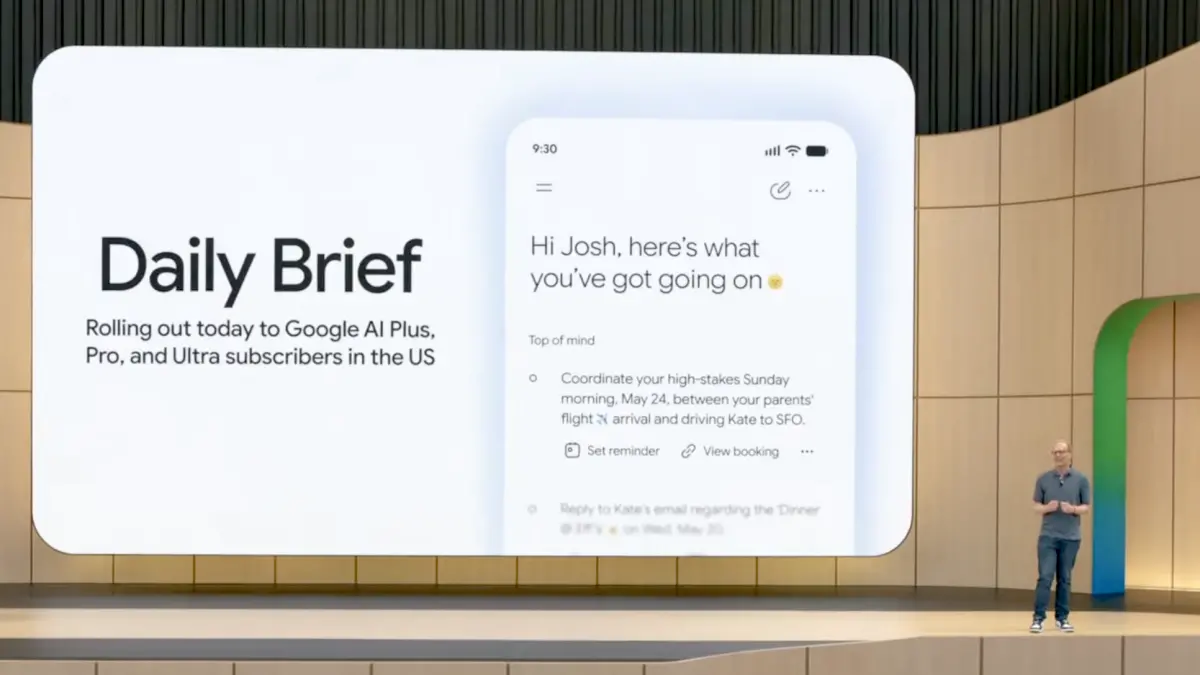
Google is quietly testing an AI-driven ‘Daily Brief’ feature that could fundamentally change how millions of people start their day. Rather than passively receiving a list of headlines or weather data, the assistant will generate a conversational, narrative-style briefing that adapts to each user’s interests, schedule, and habits. The new feature, first spotted in beta code for the Google Assistant app, leverages large language models similar to those powering Gemini to summarize multiple information sources into a coherent, spoken digest.
What is the AI Daily Brief?
The Daily Brief is designed to be a proactive, intelligent replacement for the traditional morning news roundup. Instead of reading a static list of top stories, users will hear a dynamically generated summary that ties together breaking news, their personal calendar, reminders, weather conditions, and even traffic updates. Google’s AI will learn from user feedback—such as skipping certain stories or asking for more detail on a topic—to refine future briefings.
According to internal documents reviewed by industry insiders, the feature builds on Google’s long-standing ambition to create a truly personalized assistant that understands context. The AI will prioritize stories based on the user’s past reading habits, location, and time of day. For example, a user who checks stock prices every morning will automatically hear market updates, while someone who follows sports will get scores and game summaries.
How It Compares to Competitors
Amazon’s Alexa already offers a “Flash Briefing” that plays third-party news podcasts, and Apple’s Siri can read headlines from select sources. However, these are largely static playlists or RSS-style feeds. Google’s approach is more akin to an AI news anchor that reformats and contextualizes information in real time. The company believes that by analyzing the user’s entire Google ecosystem—Gmail, Calendar, Search history, Maps, and YouTube—it can create a briefing that feels less like an audio feed and more like a personal assistant who knows what matters to you.
Microsoft has also been investing in AI-driven news aggregation with Copilot, but its focus has been on text-based summaries within Bing. Google’s Daily Brief is distinctly voice-first, positioning it as a direct competitor to the smart speaker market dominated by Amazon and Apple.
Privacy and Data Concerns
With great personalization comes great privacy scrutiny. The Daily Brief requires access to a vast amount of personal data: reading history, location, calendar events, emails, and more. Google has stated that all processing will happen on-device when possible, and users will be able to review, delete, or pause data collection at any time. The company is also introducing a new “Briefing Privacy Dashboard” that shows exactly what data was used to generate each day’s briefing.
Nevertheless, critics worry that this feature could normalize the constant surveillance of daily habits. Digital rights groups have called for Google to offer an opt-in-only model that does not require the full suite of permissions. In response, Google has indicated that a “lite” version using only public news feeds will be available for privacy-conscious users.
Under the Hood: How the AI Works
At its core, the Daily Brief relies on a fine-tuned version of Google’s Gemini large language model. The system first compiles a list of candidate stories from Google News, RSS feeds, and the user’s own data (such as upcoming appointments). Then it ranks them by relevance using a combination of collaborative filtering (what similar users liked) and content-based scoring (how closely a story matches the user’s known interests). Finally, Gemini generates natural language summaries that are spoken by a synthesized voice that can be customized for tone and speed.
The model is also trained to ask clarifying questions. If a user interrupts to ask “Why is this important?” or “Tell me more about the economy point,” the assistant will expand on that section without starting the entire briefing over. This interactive capability marks a significant step beyond simple text-to-speech.
Integration with Other Google Services
The Daily Brief is expected to be tightly integrated with Google’s broader ecosystem. For instance, if a user has a flight booked in Gmail, the morning briefing will automatically include the flight time, gate number, and weather at the destination. If the user frequently visits a certain coffee shop, the assistant might mention a new promotion they’d like. Google also plans to let third-party developers create “Briefing Skills” that add specialized content—such as stock alerts, recipe ideas, or podcast highlights—directly into the daily flow.
This integration gives Google an advantage over pure-play news apps like SmartNews or Bulletin, which lack access to the user’s personal calendar and habits. However, it also raises the bar for accuracy: a mistake in reading a calendar event or misquoting a news story could erode trust quickly.
Timeline and Availability
Sources indicate that Google plans to launch the Daily Brief as a beta feature within the Google Assistant app for Android and iOS in the coming months, with a wider rollout expected by early 2026. Initially, it will be available only in English and only for users who have opted into Google’s “AI Ultra” tier (a rumored $19.99/month subscription that includes Gemini Spark and other premium AI tools). A free version with limited personalization may follow later.
Google is also testing a display-based version for smart screens like the Nest Hub, where users will see a visual card for each story alongside the voice narration. The company hopes that the Daily Brief will become a daily habit comparable to checking email or social media—a frictionless way to stay informed without the addictive doomscrolling.
Potential Impact on News Consumption
If successful, the Daily Brief could reshape how people consume news. Instead of bouncing between dozens of apps and websites, users would get a curated, summarized experience in under three minutes. Publishers may see shifts in traffic, as fewer users click through to full articles. Google has promised to share ad revenue with news organizations whose stories are featured, but the details remain vague.
Meanwhile, the feature could exacerbate filter bubbles if the AI over-optimizes for what the user already likes. Google says its algorithm includes a “serendipity engine” that purposefully injects stories from opposing viewpoints or topics the user rarely engages with, to promote a balanced diet of information. Whether this works in practice remains to be seen.
The Role of Gemini Spark
Google’s recently announced Gemini Spark—a 24/7 cloud-based personal AI agent—will be the backbone of the Daily Brief. Gemini Spark is designed to continuously learn from user interactions across devices, creating a persistent memory of preferences and context. The Daily Brief is one of its flagship applications. During the unveiling event, Google demonstrated how Gemini Spark could edit the briefing on the fly: if a user says “I don’t care about sports today,” the model will remember that preference and adjust the next day’s content accordingly.
Interestingly, Google is also exploring a “Briefing Timer” feature, allowing users to set a fixed length (e.g., 2 minutes, 5 minutes, or 10 minutes). The AI will then automatically trim or expand stories to fit the time budget, prioritizing the most important information first. This kind of dynamic length control is unprecedented in consumer AI assistants.
Early Critics and Challenges
Not everyone is enthusiastic. Some journalists worry that algorithmic summaries will strip nuance from complex stories. Others point to the risk of hallucinations—when AI generates plausible but incorrect details—which could be particularly damaging in a news context. Google has implemented a “citation layer” that includes a quietly spoken source for each fact (e.g., “According to the BBC”), but users may not always catch these attributions.
On the technical side, generating a coherent multi-topic briefing that flows naturally is enormously difficult. Early testers report that the transitional phrases can feel repetitive (“Next up...”) and that the AI occasionally misjudges the importance of a story. Google is iterating quickly, using reinforcement learning from human feedback to smooth out the experience.
What This Means for the Future
The Daily Brief is more than just a convenience feature—it represents Google’s vision of an ambient, always-on AI that anticipates user needs before they are expressed. If it catches on, we could see similar briefings for other parts of the day: a “Work Brief” with project updates, an “Evening Brief” with entertainment recommendations, or a “Weekend Brief” with local events. Google has already filed patents for a system that generates a personalized audio newsmagazine, complete with interviews and soundbites, entirely by AI.
Ultimately, the success of the Daily Brief will depend on whether users trust the AI to be both accurate and respectful of their privacy. Google has a mixed record in both areas, but the potential payoff—a loyal base of users who rely on the assistant for daily decision-making—is enormous. As the feature slowly rolls out to beta testers, the world will be watching to see whether the AI-driven briefing becomes a beloved morning ritual or another example of technology overreaching its grasp.
Source: Mashable News