

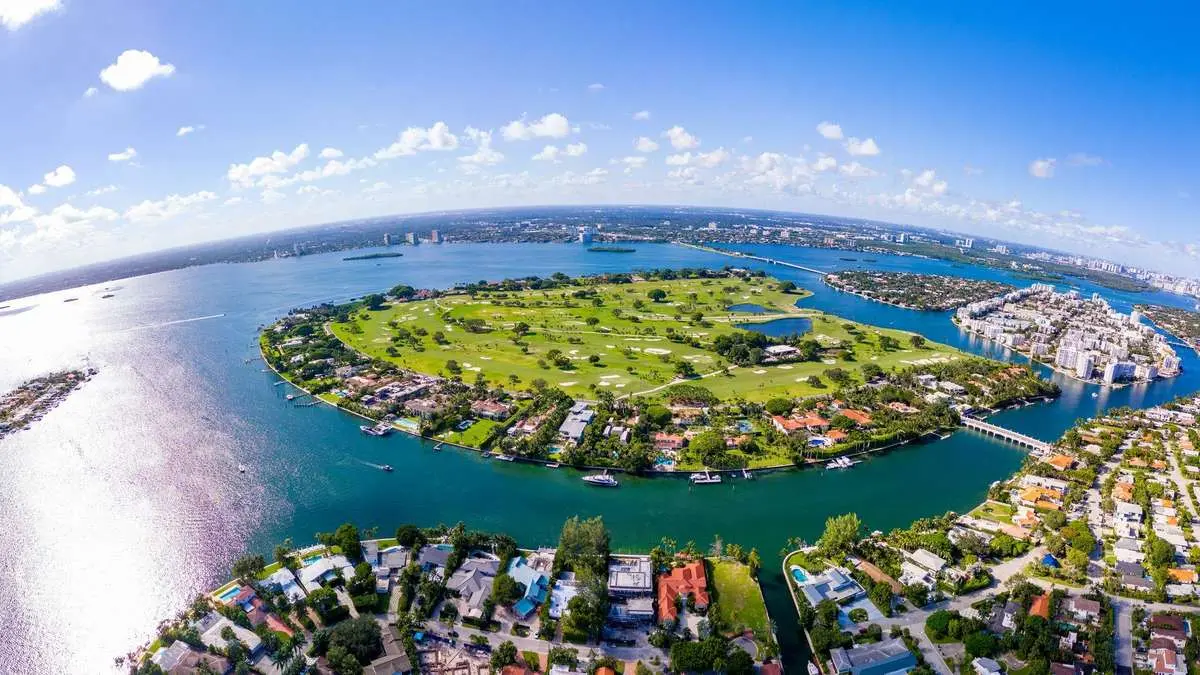
Indian Creek Island, a small artificial island in Biscayne Bay near Miami Beach, has earned the nickname "Billionaire Bunker" for its extraordinary concentration of ultra-wealthy residents. Among its notable inhabitants are Meta CEO Mark Zuckerberg, Amazon founder Jeff Bezos, former President Donald Trump, and retired NFL star Tom Brady. This exclusive enclave, spanning just 300 hectares, offers unparalleled privacy, security, and tax advantages that have made it a magnet for the world's richest individuals.
The History and Development of Indian Creek
Indian Creek Island was artificially created in the early 20th century, originally intended as a luxury residential community. Over the decades, it evolved into one of the most exclusive addresses in the United States. The island is gated and patrolled by its own private police force, which monitors both land and water access around the clock. This level of security is a major draw for high-profile figures seeking refuge from paparazzi and potential threats.
The island's governance is independent, with its own village council and municipal services. Residents enjoy a low-density environment with large estates, many featuring private docks for yachts. The median home price on Indian Creek exceeds $50 million, making it one of the most expensive neighborhoods in the world.
The Billionaire Residents: Who Lives on the Island?
The roster of Indian Creek residents reads like a who's who of global wealth and influence. Mark Zuckerberg recently purchased a property for $170 million, making it one of the most expensive home sales in Florida history. He has begun construction on a massive compound that includes a private gym, spa, and waterfront amenities. Reports suggest he plans to build a state-of-the-art family compound with underground parking, a private cinema, and extensive outdoor entertaining spaces. This investment signals his long-term commitment to Florida, following his earlier criticism of California's regulatory environment.
Jeff Bezos owns three properties on the island, including a $90 million mansion and two adjacent lots for $30 million and $40 million respectively. His superyacht, Koru, regularly visits the island, anchoring in Biscayne Bay. Bezos's presence has spurred additional interest from other tech billionaires, including Google co-founders Larry Page and Sergey Brin, though they have yet to purchase property on the island. Donald Trump also maintains a residence, though his primary home remains in Palm Beach. Other notable residents include Ivanka Trump and Jared Kushner, who live in a $30 million estate, as well as DJ David Guetta and former football quarterback Tom Brady. Brady's $15 million waterfront home serves as a base for his business ventures.
Together, the combined net worth of Indian Creek's residents is estimated to be greater than the gross domestic product of countries like Austria or Greece. This staggering wealth concentration has drawn criticism from commentators like Markus Lanz, who in his podcast "Lanz + Precht" highlighted the moral and economic implications of such inequality.
Tax Haven Appeal: Why Billionaires Flock to Florida
One of the primary reasons billionaires relocate to Indian Creek is Florida's favorable tax climate. The state has no personal income tax, no estate tax, and relatively low property taxes. This stands in stark contrast to states like California, which have proposed a "Billionaire Tax" — a one-time wealth tax of 5% on fortunes exceeding $1 billion. Such proposals have prompted a migration of the ultra-wealthy to Florida.
Investor Peter Thiel, co-founder of PayPal and Palantir, moved his companies to Florida at the beginning of the year, citing the state's business-friendly environment. The influx of billionaires has boosted the local economy, but also driven up real estate prices and contributed to a growing wealth divide in the Miami area. Florida's lack of disclosure requirements also appeals to billionaires who value privacy. Indian Creek's private police force and gated access ensure that residents can go about their daily lives without public scrutiny. The island is not accessible to tourists or the general public, making it a true sanctuary for the elite.
Security and Lifestyle on the Billionaire Bunker
Life on Indian Creek is characterized by extreme security and exclusivity. The island's police force is funded by residents and conducts patrols by boat and vehicle. Access is limited to residents, their guests, and authorized personnel. This has made Indian Creek virtually immune to paparazzi and unauthorized visitors.
The lifestyle is oriented around water activities. Many homes have private docks that can accommodate superyachts. The island has a golf course, tennis courts, and a private marina. Despite its small size, residents have access to world-class amenities. The nearby city of Miami Beach offers fine dining, shopping, and cultural attractions, while the island itself provides a quiet retreat.
However, critics argue that such extreme wealth segregation undermines social cohesion. The concentration of billionaires on a single island, shielded from the economic realities of the rest of Florida, raises questions about fairness and the erosion of progressive taxation. As Markus Lanz put it, "It makes you sick — not because you don't envy their wealth, but because you understand how much wealth and influence is concentrated in the hands of very few."
The Governance and Infrastructure of Indian Creek
Indian Creek Village was incorporated in 1936, making it one of the oldest gated communities in Florida. The village council consists of residents who serve on committees overseeing security, landscaping, and infrastructure. The private police force includes 24 officers who patrol the island and its waterways. Residents pay an annual assessment that covers operational costs, which can be substantial given the level of service.
The island's location in Biscayne Bay provides natural protection from storms, but it also requires careful environmental management. The mangroves and waterways are preserved as part of local conservation efforts. Climate change poses a long-term risk due to sea-level rise, but the wealthy residents have the resources to adapt, including seawalls and elevation projects.
Comparison to Other Billionaire Havens
Indian Creek is often compared to Fisher Island, also in Miami Beach, which is accessible only by ferry. However, Fisher Island is more diverse in terms of wealth tiers. Star Island is another exclusive enclave, but it lacks the same level of security and privacy. In California, the Holmby Hills neighborhood in Los Angeles houses many billionaires, but it lacks the island's seclusion. The "Billionaire Bunker" nickname is unique to Indian Creek due to its high density of ultra-wealthy individuals.
Other similar communities include the Hamptons in New York and the French Riviera, but Indian Creek's combination of tropical climate and tax advantages is unmatched. The island's close proximity to Miami International Airport also makes it convenient for billionaire jet travel.
The Wealth Inequality Debate
The existence of Indian Creek has become a symbol of the growing wealth gap in the United States and globally. While the island's residents pay low taxes, many critics argue that they benefit disproportionately from public infrastructure and services without contributing their fair share. The proposed Billionaire Tax in California aims to address this imbalance, but the migration to Florida shows that wealthy individuals are willing to relocate to avoid higher taxes.
Economists are divided on the impact of such enclaves. Some argue that billionaires stimulate local economies through spending and investment. Others contend that the concentration of wealth leads to political influence that further tilts the scales in favor of the rich. The presence of figures like Jeff Bezos and Mark Zuckerberg on Indian Creek also raises antitrust and regulatory concerns, as these individuals control vast digital ecosystems.
During the 2026 presidential campaign, President Donald Trump's residency on Indian Creek became a campaign issue. He has continued to maintain a property there, despite his official residence in Palm Beach. Critics have used this to highlight the disconnect between wealthy politicians and ordinary Americans.
In his podcast, Markus Lanz observed that much of the political spectacle in the United States is designed to avoid asking the fundamental question: "Why the hell don't you pay fair taxes?" This sentiment resonates with many who see Indian Creek as a glaring example of inequality. Beyond politics, the island's exclusivity also impacts local housing markets. In Miami-Dade County, the influx of billionaires has driven up luxury real estate prices, making affordable housing even scarcer. Community activists have called for policies to mitigate the effects of such wealth concentration, including stricter regulations on foreign investment and land use.
Markus Lanz and the Broader Social Commentary
Markus Lanz's criticism on his podcast with Richard David Precht went viral, sparking debates across German and international media. Lanz expressed disgust at the concentration of wealth, arguing that it undermines democratic principles. He noted that the collective net worth of Indian Creek residents exceeds Austria's entire economic output, a nation of 9 million people. This comparison highlights the extreme disparity between the island's inhabitants and the rest of society.
Precht added philosophical reflections on inequality, referencing John Rawls's theory of justice. The podcast episode became a touchstone for discussions about tax fairness, particularly in the context of the planned Billionaire Tax in California. Critics of the tax argue that it would drive more wealthy individuals to Florida, exacerbating the very problem it aims to solve. Ultimately, Indian Creek Island remains a microcosm of the larger debate about wealth and power in the 21st century. Its residents enjoy unparalleled luxury and freedom, while the world watches and questions whether such concentrations are compatible with a just society.
Source: Merkur News