

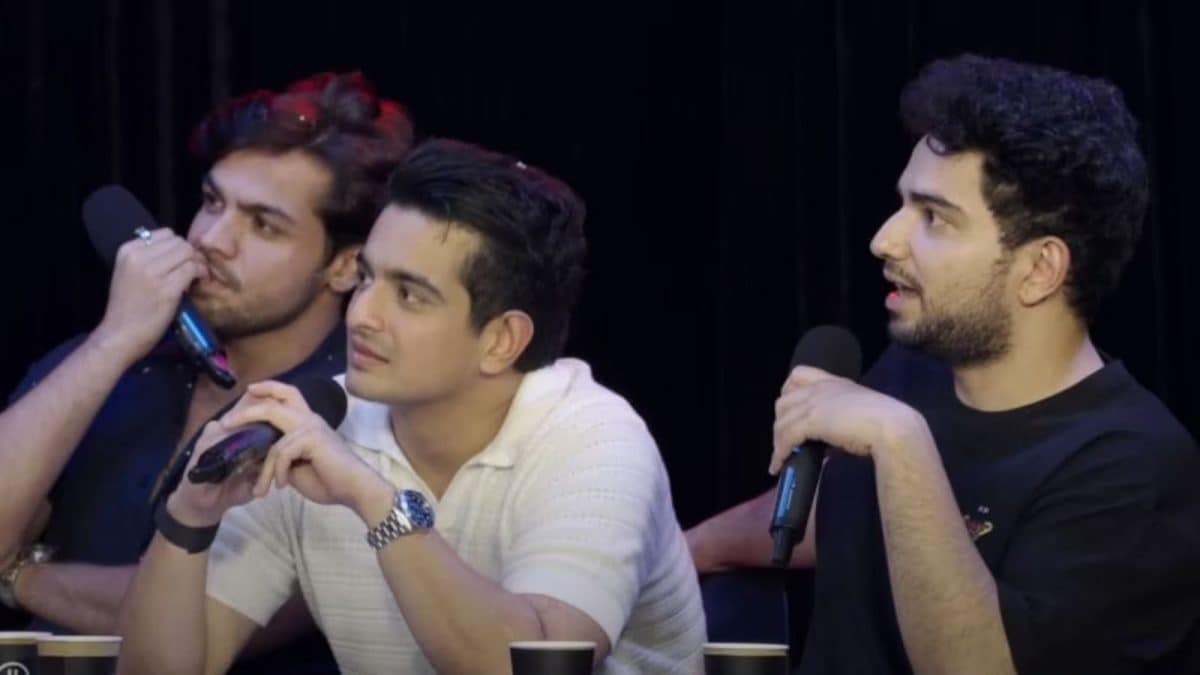
An 18-year-old audience member who attended the now-deleted episode of India's Got Latent has come forward to reveal what Ranveer Allahbadia said to the contestant immediately after his controversial 'sex with parents' joke. Mohit Khubani, who was present in the Mumbai audience, said that Allahbadia repeatedly apologised to the contestant and asked if his question had made him uncomfortable. According to Khubani, after the contestant won the show's 'pointless reality show' segment, Allahbadia walked up to the stage and hugged him in an attempt to defuse the tension.
Khubani shared a video on Instagram explaining what truly transpired during the filming of the episode, noting that he 'might delete it later'. He said, 'This is what happened in that episode of India's Got Latent. It's fully unfiltered.' In the video, Khubani defended the panellists, saying that they made sure the contestant was comfortable while they made jokes. He added, 'I don't want my favourite creators getting hate for no reason because half of the people don't even know what happened in that episode.'
The Controversial Question That Sparked a Nationwide Row
The controversy erupted after a clip from the episode went viral, showing Ranveer Allahbadia asking a male contestant: 'Watch your parents have sex every day for the rest of your life, or would you join in once and stop it forever?' He also asked the same contestant about the length of his penis, using a crude term. The question was widely condemned as obscene and insensitive, leading to a massive backlash on social media and multiple police complaints across the country.
Even Samay Raina, the show's host, was caught off guard by Allahbadia's remark. In the viral clip, Raina is heard reacting with 'What the f?' and then asking, 'Kya ho gaya hai Ranveer bhai ko? [What has happened to Ranveer?]' Raina, known for his own dark and edgy humour, appeared visibly shocked by the question's explicit nature.
Background: Who Is Ranveer Allahbadia?
Ranveer Allahbadia, popularly known as BeerBiceps, is one of India's most prominent YouTubers and podcasters. With millions of subscribers across his channels, he built his career on motivational content, fitness advice, and long-form interviews with celebrities, entrepreneurs, and thought leaders. His podcast, The Ranveer Show, has featured guests ranging from Bollywood actors to spiritual leaders, earning him a reputation as a versatile digital creator.
Despite his mainstream success, Allahbadia has occasionally dabbled in edgier content, often pushing the boundaries of what is considered acceptable in India's conservative digital landscape. His appearance on India's Got Latent, a comedy show hosted by Samay Raina, was seen as an attempt to connect with a younger, more meme-savvy audience. The show, known for its unfiltered and often offensive humour, had already faced criticism for its content, but Allahbadia's question took things to a new level.
What Is India's Got Latent?
India's Got Latent is a YouTube comedy show created by stand-up comedian Samay Raina. The show features amateur contestants performing bizarre or pointless tasks, while a panel of judges – often fellow comedians and influencers – reacts with sarcastic commentary. The format deliberately invites chaos, with contestants encouraged to say or do almost anything for entertainment. The show gained a cult following for its raw humor and unpredictable moments, but it also drew complaints for crossing lines of decency.
The episode in question had Ranveer Allahbadia as a guest judge alongside YouTuber Ashish Chanchlani, comedian Jaspreet Singh, and content creator Apoorva Mukhija, who is known online as The Rebel Kid. During the taping, the panel engaged in crude banter, but it was Allahbadia's question to a contestant that triggered the most severe reaction.
Outrage, Apologies, and Deletion of the Show
The backlash was immediate and intense. Social media users, parents' groups, and politicians called for a ban on the show and legal action against all those involved. Multiple FIRs were filed against Samay Raina, Ranveer Allahbadia, Ashish Chanchlani, Jaspreet Singh, and Apoorva Mukhija in different states, including Maharashtra, Assam, and Rajasthan. The complaints alleged that the remarks were obscene and violated Indian laws on indecent representation and cybercrime.
As the pressure mounted, Ranveer Allahbadia issued a public apology. He admitted to a 'lapse of judgement' and said his question was inappropriate. In a statement, he said, 'I personally had a lapse of judgement. I didn't think about the impact of my words. I was just trying to be funny, but I failed. I am deeply sorry.'
Samay Raina also reacted by removing all episodes of India's Got Latent from his YouTube channel. He wrote, 'Everything that is happening has been too much for me to handle. I have removed all India's Got Latent videos from my channel. My only objective was to make people laugh and have a good time. I will fully cooperate with all agencies to ensure their inquiries are concluded fairly. Thank you.'
The Supreme Court's Intervention
With multiple FIRs filed against him in different jurisdictions, Ranveer Allahbadia approached the Supreme Court seeking to consolidate the cases and obtain protection from arrest. His lawyer, Advocate Abhinav Chandrachud, told the court that Allahbadia had been receiving death threats and feared for his safety.
The Supreme Court, however, expressed strong disapproval of the language used by the YouTuber. Justices Surya Kant and N. Kotiswar Singh heard the case and sharply questioned whether the remarks constituted obscenity. 'We would like to know that in this country if this is not obscenity then what is?' the court asked. The justices also stated, 'There is a height of irresponsibility. They believe that since they've become popular they can say anything. There's dirt in his mind. Why should the court favour such a person?'
Despite the stern remarks, the court granted Allahbadia interim protection from arrest, while making it clear that he must cooperate with the ongoing investigations. The court also suggested that the multiple FIRs could be clubbed together to avoid harassment, but it did not dismiss the charges.
The Free Speech Vs. Obscenity Debate
The controversy has reignited a fierce debate in India about the limits of free speech in the digital age. Supporters of Allahbadia argue that comedians and content creators should have the freedom to push boundaries and that the outrage is an overreaction to a clearly silly, hypothetical question. They point out that the contestant himself did not seem distressed, as revealed by Khubani's account, and that the show's format is explicitly edgy and unscripted.
Critics, however, insist that the joke crossed a fundamental line of decency and respect for family relationships. Many find the specific reference to parents and the sexualisation of a family bond deeply offensive, regardless of the context. This is not just about crude language; it reflects a broader concern about the kind of content that is being normalised for young audiences on platforms like YouTube.
Legal Implications and the Role of Digital Platforms
The case also raises important questions about the responsibility of digital platforms in regulating content. YouTube and other social media sites have community guidelines that prohibit obscene or harmful material, but enforcement is often inconsistent. The fact that the episode was allowed to air and remained online for days before being deleted highlights the challenges of moderating live or rapidly uploaded content.
Legal experts note that India's obscenity laws, which date back to colonial times, are difficult to apply to modern digital content. The Supreme Court has previously held that obscenity must be judged by contemporary community standards and that art and satire are protected. However, the court's sharp language in this case suggests that it views Allahbadia's remark as far beyond any legitimate artistic or satirical purpose.
The incident also underscores the vulnerability of content creators who rely on shock value for attention. In an increasingly competitive digital economy, the pressure to go viral can lead to reckless decisions, as seen here. While freedom of expression is a fundamental right, it is not absolute, and creators must operate within the bounds of the law and social norms.
Reaction from the Entertainment Industry and Public
The incident has drawn reactions from across the entertainment industry, with some comedians defending Allahbadia and others condemning him. Fellow YouTubers and podcasters have weighed in, with many calling for a more responsible approach to humour. Some have pointed out that the backlash could have a chilling effect on comedy in India, making creators more hesitant to experiment with edgy material.
Meanwhile, the public remains divided. A large segment of social media users has called for a boycott of Allahbadia's content, while others have expressed support, citing his past work and charitable initiatives. The hashtag RanveerAllahbadia trended for days on Twitter, with users sharing clips and opinions both for and against him.
What Happens Next?
As of now, Ranveer Allahbadia has been granted interim protection from arrest, but the legal battle is far from over. The Supreme Court is expected to hear further arguments on whether the multiple FIRs should be consolidated and whether the remarks amount to obscenity under the law. Samay Raina, who is also named in the FIRs, has cooperated with authorities, and his lawyers have stated that he is prepared to face the legal process.
The audience member Mohit Khubani's account adds a human dimension to the controversy, suggesting that the contestant was not visibly upset during filming. However, this has done little to quell the public outcry. For many, the issue is not about the reaction of one individual but about the broader message that such content sends to society.
In the meantime, India's Got Latent remains offline, and it is unclear whether the show will ever return. Samay Raina has not indicated any plans to resume production. The episode has become a cautionary tale for content creators about the risks of pushing boundaries without considering the consequences. As the legal proceedings continue, the case will likely set important precedents for how India regulates online speech and creative expression.
Source: News18 News