

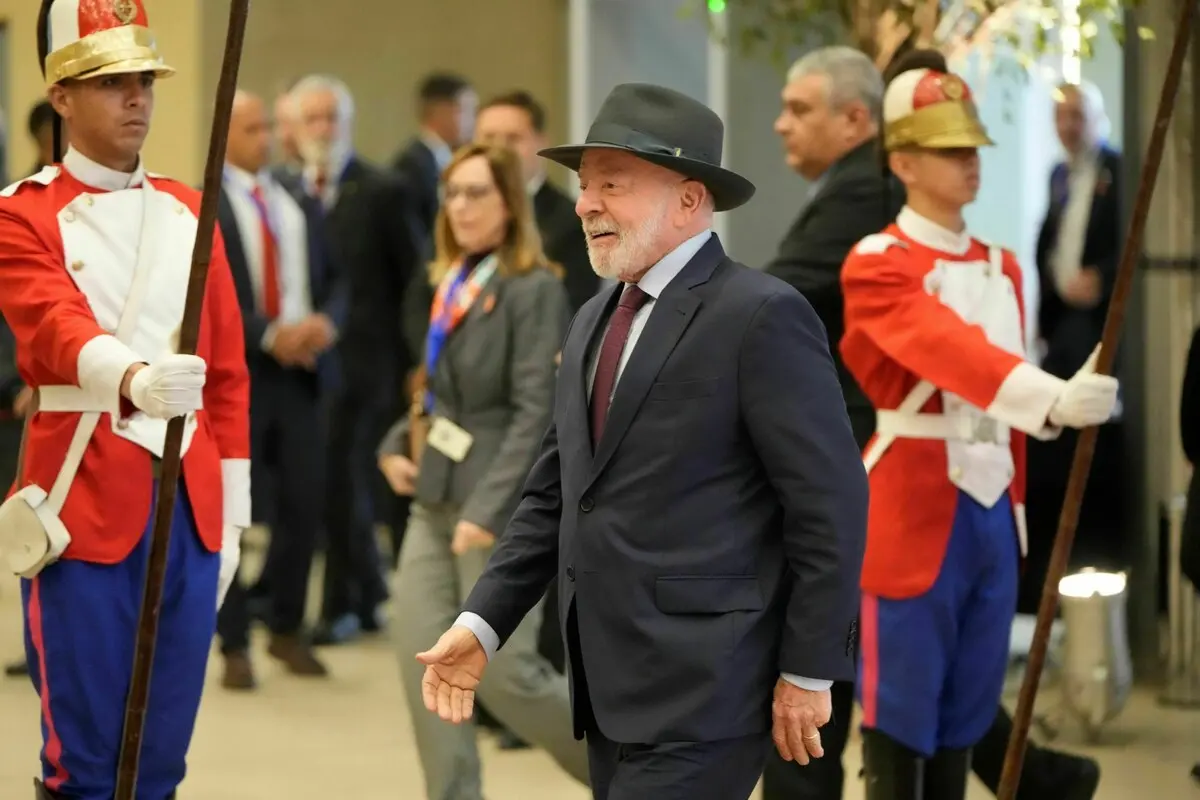
It was supposed to be a routine summit of the presidents of the member and associate states of the South American economic bloc Mercosur, held on Tuesday in the Paraguayan capital of Asunción. But much like at the last summit, when Brazil's leftist President Lula da Silva did not attend, this time his right-libertarian counterpart Javier Milei of Argentina canceled at the last minute.
Instead, Argentina's president demonstratively hosted Flavio Bolsonaro in Buenos Aires two days earlier. It was another gesture of support ahead of the presidential election on October 4 in Brazil, where the son of far-right former President Jair Bolsonaro will challenge Lula. The political landscape in South America has shifted dramatically in recent years. Once a region with a strong leftist presence, today right-wing and far-right leaders hold power in most countries. Lula, a veteran leftist who returned to office in 2023, now finds himself as one of the few progressive voices at the regional table.
Lula countered deftly, describing at the summit table the situation he had found upon taking office in 2023: a non-functioning administration as a result of the mass layoffs under his predecessor Bolsonaro, millions of people in poverty, an abolished women's ministry, and suspended rights for minorities. It was campaign rhetoric against Bolsonaro Junior and at the same time a description of what Milei might one day leave behind in Argentina. Yet Lula threatens to become a left-wing admonisher in a right-wing desert. Apart from social-democratic President Yamandú Orsi of Uruguay, only right-wing and far-right heads of state will sit at the table in the future. In the associate states of Chile, Peru, and Colombia, right-wing presidents are or will soon be in office. Social issues remained no more than dutifully added phrases in all the speeches of the summit participants.
State of Emergency in Bolivia
A foretaste of what is to come was provided by the president of Bolivia. Rodrigo Paz, in the face of protests in Bolivia, spoke of a looming "South American spring" in allusion to the Arab Spring, when millions of people in North Africa and the Arabian Peninsula took to the streets in 2010. The protests by Bolivian unions, farmers, and workers are directed against the economic crisis in the country and the political projects of Paz's right-wing conservative government. Two weeks earlier, Paz had declared a state of emergency across the country. In the final declaration of the Mercosur summit, the member states expressed their concern about the situation in Bolivia after seven weeks of protests.
The summit also brought criticism from Paraguayan President Santiago Peña about the "asymmetries" arising from the free trade agreement with the European Union. The South American governments are arguing over who can deliver which products to the EU and in what quantity. "What is the point of an agreement that reproduces existing asymmetries instead of correcting them?" asked the host president. After the agreement was ratified by the four founding Mercosur states of Argentina, Brazil, Paraguay, and Uruguay, the European Commission put it into force on May 1, even though ratification by the European Parliament is still pending because MEPs have tasked the European Court of Justice (ECJ) with reviewing it. There will be no turning back despite the still-pending ECJ decision. The more and the faster facts are created now, the more likely the agreement will hold, was the consensus among its supporters.
Furthermore, at the end of the summit, the formal start of negotiations on a free trade agreement with Japan was announced. Uruguay declared that it would move closer to an agreement with Japan in the coming months. The summit underscored a broader shift in global trade dynamics, with South American countries seeking to diversify their partnerships beyond traditional Western allies. The EU, however, remains a major trading partner, and the implementation of the Mercosur-EU deal has been controversial. Critics argue it benefits large agribusinesses at the expense of small farmers and the environment, while supporters claim it will boost economic growth and integration.
Lula's position is increasingly precarious. As a leftist leader in a conservative bloc, he must navigate both domestic challenges and regional pressures. Brazil, the largest economy in South America, holds significant influence, but Lula's ability to shape Mercosur's direction is limited by the lack of ideological allies. The summit also highlighted the growing rift between democratic governance and authoritarian tendencies in the region. In Bolivia, the state of emergency has drawn international condemnation, with human rights groups warning of repression against protesters.
The economic context is equally challenging. Inflation, debt, and social inequality plague many Mercosur countries. The pandemic exacerbated existing vulnerabilities, and recovery has been uneven. Trade negotiations with Japan and the EU are seen as opportunities to boost exports and attract investment, but they also raise concerns about labor standards and environmental protection. Environmentalists fear that increased trade could accelerate deforestation in the Amazon and other sensitive ecosystems. Lula, who previously oversaw a reduction in deforestation during his earlier terms, has made environmental protection a cornerstone of his administration. However, he faces resistance from powerful agricultural interests.
As the summit concluded, the absence of many leaders and the contentious debates served as a reminder of the challenges facing Mercosur. The bloc, founded in 1991 to promote free trade and economic integration, has struggled to maintain relevance in a rapidly changing global economy. Internal divisions and political shifts have hindered progress on key initiatives. Yet, the fact that negotiations with Japan have begun suggests that Mercosur members are still committed to expanding their trade networks. For Lula, the path forward will require careful balancing of domestic priorities and regional realities. The 2026 Brazilian election will be a critical test, not only for his presidency but for the future of progressive politics in South America.
The meeting also provided a platform for smaller member states like Paraguay and Uruguay to voice their concerns. Uruguay, under President Orsi, has been pushing for more flexibility to negotiate bilateral trade deals outside the Mercosur framework. This has created tension with Brazil, which prefers a unified bloc approach. The debate over the EU agreement reflects these broader tensions. While larger economies like Brazil and Argentina stand to gain from increased access to European markets, smaller countries fear being overshadowed. The Japanese negotiations could offer a middle ground, but they are still in early stages.
In addition to trade, security and migration were discussed informally among the leaders. The region faces challenges from organized crime, drug trafficking, and political instability. The crisis in Bolivia is symptomatic of deeper governance issues, where weak institutions and economic mismanagement fuel unrest. Lula has called for a peaceful resolution and respect for democratic processes, but his influence is limited. The right-wing governments in the region have shown little appetite for collective action on social or environmental issues. Instead, they emphasize national sovereignty and economic liberalization.
Lula's detention in 2018 on corruption charges, which were later annulled, made him a symbol of judicial persecution for his supporters. His return to power was seen as a victory for democracy. However, the political environment in Brazil remains polarized, and his government has faced numerous challenges, including a conservative Congress and a powerful agribusiness lobby. The Mercosur summit reflected these domestic struggles, as Lula used the international stage to burnish his credentials ahead of the election. His speech resonated with his base, but it remains to be seen whether it will sway undecided voters.
The future of Mercosur hangs in the balance. If the trend toward right-wing governments continues, the bloc may shift further away from the social integration goals that were part of its original vision. Trade deals will likely prioritize corporate interests over human rights and environmental sustainability. Yet, Lula's presence, even as a lone leftist, ensures that these issues remain part of the conversation. The 2026 summit, scheduled to take place in Brazil, will be a crucial moment to assess the bloc's trajectory. Until then, Lula will continue to navigate the complexities of a region in flux, advocating for a more equitable and sustainable model of development.
Source: taz.de News