

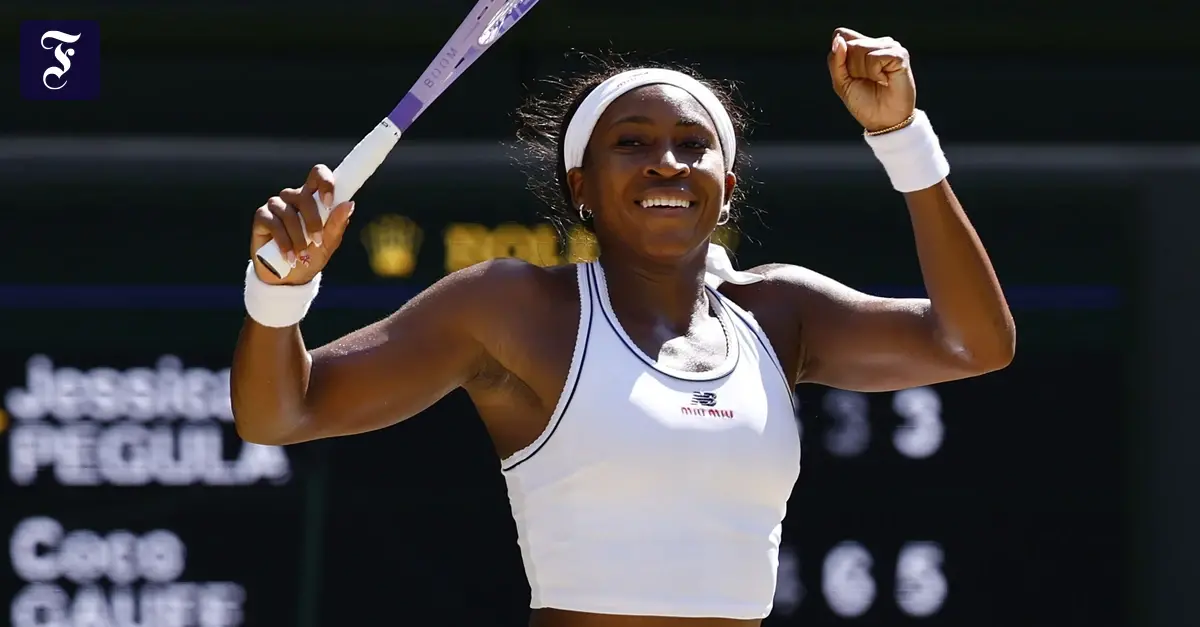
Wimbledon, 2019. A teenager becomes a sensation. Her name is Cori Gauff, 15 years old, who learned tennis on the hard courts of Georgia and Florida. In London, Gauff plays on grass for the first time, wins her three qualifying matches, and in the first round of the main draw faces the great Venus Williams, a five-time Wimbledon singles champion. Gauff wins in straight sets and continues her winning streak until the fourth round, where she loses to eventual champion Simona Halep. Soon, the tennis world is sure, the teenager will become a hot title contender at Wimbledon.
What has come of the American on grass in the seven years since? Very little. In the past two years, even nothing. Wherever Gauff played on the natural surface, she lost to significantly lower-ranked opponents. Now Cori Gauff, whom everyone calls "Coco," stands in the semifinals of Wimbledon. "Oh my God – how?" shouted the now 22-year-old after her quarterfinal victory up to her coaching team. A legitimate question.
Before Gauff, hundreds of tennis pros have struggled with or cursed the grass, and hundreds more will after her. The surface is more or less damp, the ball bounces lower, and the game is faster than, for example, on clay courts. Players must adjust their footwork, slide. Over the course of the tournament, the court becomes balder and bumpier, balls bounce more unpredictably. "Grass is only for cows," said Ivan Lendl, who won eight Grand Slam titles but none at Wimbledon, once resignedly. Since the grass season with its peak at Wimbledon lasts only one month, there is little time to learn. Coco Gauff, who like Lendl has won her major titles on clay and hard court, has managed it anyway. How?
Gauff Is Different from the Army of Frustrated Players
The world number seven believes she possesses all the skills to play well on grass: "It's more about self-confidence." Her belief in herself increased round by round. Against Hamburg's Tamara Korpatsch, the new German number one, things went smoothly. Then Gauff had to give everything and go the distance four times over three sets. Twice she gave up a set lead, twice she had to come from behind, most recently on Tuesday against her compatriot Jessica Pegula.
Unlike Lendl and the army of frustrated players, Gauff has found a way: She has not perceived the grass as the determining factor, but rather herself. At first, she tried to play as is promising on the surface and as she did carefree at her Wimbledon debut seven years ago against Venus Williams: offensively, aiming for the point as quickly as possible. Gauff has the serve for that, and her athleticism can shine anywhere. But this quick-fire approach on grass does not suit the American; she made many errors.
So against Pegula, she fell back on what helped her win the US Open in 2023 and the French Open in 2025. "I realized that I don't have to play a spectacular rally every time to win," said Gauff. "I think it's just about trusting myself and relying on the fact that my groundstrokes are good enough to compete with any opponent on this surface."
Inspired by Swiatek
For this approach, Coco Gauff has found a role model: Iga Swiatek, whose style of play with lots of tactics, heavy topspin, and controlled offense is just as suited for clay court tennis as that of her idol Rafael Nadal. Nevertheless, the four-time French Open winner from Poland won Wimbledon last year, and the 14-time Roland Garros champion Nadal even won twice. For Gauff, there is a connection between a good performance in Paris and a less good one in London. "That is the biggest factor why there have been so many different winners in recent years." She herself was so exhausted after the months-long clay court season in 2025, culminating in her French Open win, that she lost immediately in the first round of Wimbledon.
This time it was the opposite: Gauff lost in Paris in the third round, was able to practice on grass in Berlin – and now has the chance to reach the final with a win over Czech Karolina Muchova. "No matter how this tournament ends. I have learned a lot from it. That can pave the way for future successes here." It is quite possible that the circle back to her sensational debut seven years ago will finally close.
Background: Gauff's Career Trajectory
Coco Gauff burst onto the scene in 2019 at Wimbledon, but her true breakthrough came later. She won her first WTA title in Linz in 2019 and then steadily climbed the rankings. In 2023, she won her first Grand Slam at the US Open, defeating Aryna Sabalenka in the final. In 2025, she added the French Open title, proving her versatility on clay. Her grass court results, however, were disappointing until now. In 2021, she lost in the first round of Wimbledon; in 2022 and 2024, she fell in the third round. Her quarterfinal appearance this year marked her best result since 2019.
The key to Gauff's turnaround on grass has been a mental shift. Instead of forcing an aggressive style, she has focused on consistency, patience, and using her defensive skills. Her serve, often cited as a weakness, has improved significantly. In her quarterfinal match against Jessica Pegula, Gauff saved 8 of 9 break points and won 78% of her first-serve points. She also showed remarkable composure in tiebreaks.
Gauff's path to the semifinals included a tough three-set win over Tamara Korpatsch, a comeback against unseeded Jule Niemeier, and a quarterfinal battle with Pegula. The American has now won four consecutive three-set matches, a testament to her mental toughness. She has also benefited from a favorable draw, with several top seeds eliminated early.
What Lies Ahead
In the semifinals, Gauff faces Karolina Muchova, a Czech player known for her all-court game and variety. Muchova knocked out Gauff in the 2023 French Open semifinals, but Gauff will have home-court advantage and momentum. If she wins, she could face either Aryna Sabalenka or Marta Kostyuk in the final. Sabalenka is the hard-hitting world number two, while Kostyuk is a surprise semifinalist.
Regardless of the outcome, Gauff has already silenced critics who doubted her ability on grass. Her run has been unconventional, marked by resilience and adaptability. She has proven that even on the most challenging surface, self-belief can overcome technical flaws. As she said after her quarterfinal win, "I just kept believing that I could find a way."
The tennis world is now watching to see if Coco Gauff can complete her improbable journey with a Wimbledon title. For a player who once struggled to win a match on grass, reaching the final four is already a triumph. But Gauff is not satisfied. She wants more. And with her newfound confidence, she might just get it.
Source: FAZ.NET News