

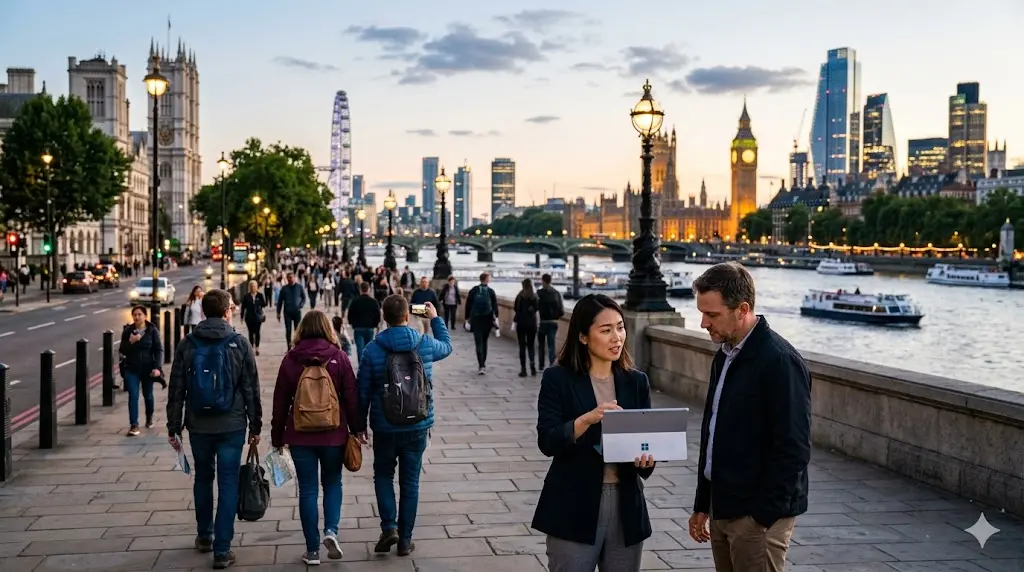
Global financial research on urban tourism shows something a bit uncomfortable: cities don’t just “earn” from tourism, they constantly reshuffle money between winners and losers inside the same urban space. You need to understand that tourism isn’t a single revenue stream—it’s a complex financial system tied to housing, transport, taxes, and even small local businesses.
Here’s the direct answer: urban tourism boosts city revenue, but it also creates hidden financial pressure points like infrastructure strain, housing inflation, and uneven income distribution. The real story is in how cities balance both sides.
Global financial research on urban tourism shows that while tourism increases GDP contribution and tax revenue, it also raises costs in housing, infrastructure, and public services. In 2026, cities are focusing on smarter pricing systems, visitor taxes, and real-time financial tracking to balance economic gains with sustainability.
Urban Tourism Economic Flow
Urban Tourism Economic Flow: The movement of money generated by tourism across city systems including hospitality, transport, housing, taxation, and local businesses.
What Is Global Financial Research on Urban Tourism?
Let’s break it down simply. This research area studies how money moves through cities because of tourism activity. Not just how much comes in, but who actually benefits and who ends up paying the cost.
Here’s the thing—tourism numbers often look impressive on paper. Millions of visitors, billions in spending. But when researchers dig deeper, the financial benefits are not evenly distributed. Hotels and large operators usually gain more than small local businesses.
In my experience, cities tend to overestimate tourism profits in early reporting because indirect costs get ignored. Things like road maintenance, waste management, and public transport expansion quietly eat into that revenue.
What most people overlook is that urban tourism acts like a financial amplifier. It doesn’t create money from nothing—it redistributes it across different sectors, sometimes unevenly.
For broader financial context, institutions studying urban economies often highlight how tourism contributes to GDP while also increasing public expenditure pressure, especially in dense metropolitan regions.
Why Global Financial Research on Urban Tourism Matters in 2026
2026 is a strange year for city economies. Travel demand is rising again, but so are operational costs for cities trying to manage large visitor flows.
Let me be direct: cities are not just competing for tourists anymore—they’re competing for profitable tourists. That subtle shift changes everything.
What most people miss is that tourism isn’t always a net gain when infrastructure costs rise faster than revenue. A city can look economically successful while actually operating on thin margins once hidden expenses are counted.
Another layer researchers are focusing on is housing pressure. Short-term rentals often increase revenue for property owners but reduce affordability for residents, which indirectly affects long-term economic stability.
From what I’ve seen in financial case studies, cities that don’t reinvest tourism taxes efficiently tend to face “leaky economy” effects—money comes in, but doesn’t circulate locally for long.
And here’s a slightly counterintuitive point: reducing tourism can sometimes improve long-term financial stability by lowering maintenance costs faster than revenue drops.
How to Analyze Financial Impact of Urban Tourism — Step by Step
If you were actually conducting financial research on urban tourism, the process usually looks like this.
1. Identify direct tourism revenue streams
Start with hotel stays, transport fees, attraction tickets, and tourism-related taxes. This is the visible money flow.
2. Measure indirect economic activity
Restaurants, retail, and entertainment often benefit from tourism without being labeled “tourism sectors.”
3. Calculate public service costs
This is where many analyses become inaccurate if ignored. Waste management, policing, infrastructure wear, and transport expansion all cost money.
4. Evaluate housing market impact
Short-term rentals and tourism-driven demand can push rents up, affecting local spending power.
5. Compare net economic gain vs public expenditure
This is the real balancing point—what comes in versus what goes out.
6. Study long-term reinvestment patterns
Cities that reinvest tourism revenue into infrastructure usually perform better economically over time.
Common Misconception About Tourism Revenue
A lot of people assume tourism money is “extra income” for cities. That’s not really true.
Here’s what actually happens: tourism revenue often replaces other forms of local spending. A visitor might spend $200 in a city, but that same infrastructure usage still requires maintenance funded by taxpayers.
So the system isn’t pure profit—it’s a shifting balance sheet.
Expert Tips: What Actually Works in Real Urban Economies
Here’s my honest take after reviewing how different cities handle tourism finance: the successful ones don’t try to maximize tourism at all costs. They optimize for balance.
In my experience, cities that introduce targeted visitor fees tend to stabilize public budgets faster than those relying only on general taxation. It’s not about charging more—it’s about charging smarter.
Expert tip: The best-performing cities track tourism revenue and public service costs together in real time. When those two datasets are separated, decision-making becomes slower and less accurate.
Another thing people rarely mention is financial leakage. If tourism revenue leaves the local economy quickly—through foreign-owned hotels or external suppliers—the city gains less long-term benefit.
Here’s a hot take: more tourists doesn’t always mean more financial health. Sometimes fewer, higher-spending visitors create better economic outcomes than mass tourism.
And honestly, I’ve seen cases where cities chasing volume ended up with strained infrastructure and weaker per-capita returns. It’s not always obvious until years later.
Real-World Financial Scenarios in Urban Tourism
Let’s make this practical.
One major city with strong tourism growth saw record-breaking visitor numbers over several years. On paper, everything looked positive—hotel occupancy rates, tax collection, and transport revenue all increased.
But when researchers factored in infrastructure maintenance, congestion management, and public service expansion, the net profit margin for the city shrank significantly. The tourism boom wasn’t as profitable as it appeared at first glance.
Another example involves a mid-sized city that introduced a structured visitor tax. At first, there was concern about reduced tourism. But what happened instead was more interesting—visitor numbers slightly stabilized, but average spending per tourist increased.
From my perspective, that second case shows something important: pricing strategy can influence not just revenue, but the type of tourism a city attracts.
Expert Insight: The Hidden Cost Structure of Tourism Cities
One thing that doesn’t get enough attention is timing mismatch.
Tourism revenue comes in quickly—hotel bookings, transport fees, seasonal spikes. But costs like infrastructure repair and public service expansion accumulate slowly and continuously.
That mismatch creates budget tension.
At least from what I’ve seen in urban financial research, cities that fail to align revenue timing with cost cycles often end up with short-term surpluses and long-term deficits.
Another overlooked factor is seasonal dependency. Cities heavily reliant on seasonal tourism face unpredictable cash flow patterns, which makes financial planning more difficult than it appears.
Unexpected Finding: Tourism Can Mask Structural Economic Weakness
Here’s something that surprises a lot of analysts.
Tourism revenue can make a struggling city look financially healthy even when its core industries are weakening. Because visitor spending is external money, it temporarily boosts economic indicators.
But if local industries decline while tourism grows, the city becomes overly dependent on external demand.
That’s a risky position, because tourism is sensitive to global shocks like economic downturns, travel restrictions, or currency shifts.
So what looks like strength can sometimes hide fragility underneath.
People Most Asked About Global Financial Research on Urban Tourism
How does urban tourism contribute to city economies?
Urban tourism generates revenue through hospitality, transport, retail, and taxes. It also indirectly supports jobs and small business activity, but benefits vary widely across sectors.
Why is tourism not pure profit for cities?
Because cities also spend heavily on infrastructure, safety, sanitation, and transport systems needed to support visitors, which reduces net financial gain.
What is the biggest financial challenge in urban tourism?
The biggest challenge is balancing revenue with infrastructure costs, especially when visitor numbers grow faster than city capacity.
Does tourism always improve local economies?
Not always. While it increases cash flow, it can also raise living costs and strain public resources if not managed properly.
How do cities maximize tourism revenue?
Cities that focus on value-based tourism, targeted taxation, and reinvestment in infrastructure tend to achieve more stable long-term returns.
If you’re looking to increase authority in financial research, tourism economics, or digital publishing, platforms like press release distribution services and digital marketing services can significantly improve SEO ranking, brand visibility, and organic traffic. Our Network site provides guest posting services, PR submission sites, and link building services designed for businesses, agencies, and startups aiming for high authority backlinks, media coverage, and instant publishing opportunities that strengthen long-term digital performance.