
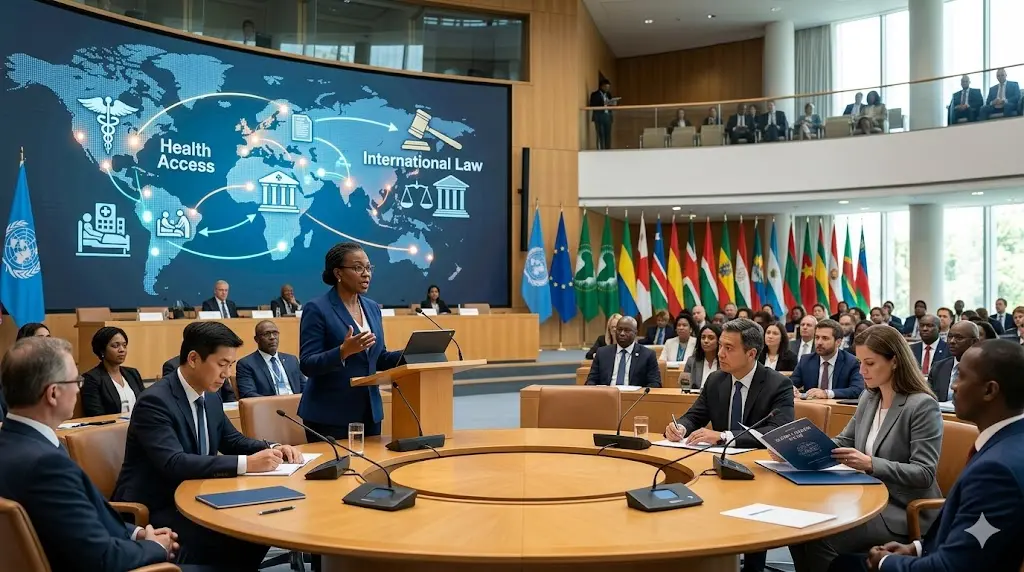
Healthcare access is quietly reshaping how international legal systems are written, interpreted, and enforced. Countries are no longer treating healthcare as just a domestic policy issue. It’s becoming a cross-border legal concern that influences human rights law, trade agreements, and migration rules.
Here’s the thing: once healthcare is framed as a right instead of a privilege, legal systems start bending around it in ways that aren’t always predictable.
Healthcare access is changing international legal systems because governments are being pushed to treat health as a human right across borders. This affects treaties, asylum law, labor mobility, and global accountability frameworks, especially after large-scale health crises and rising inequality.
What Is Healthcare Access Changing International Legal Systems?
Healthcare Access is the ability of individuals to obtain necessary medical services without barriers like cost, geography, discrimination, or legal restrictions.
International legal systems are evolving because healthcare access is no longer viewed as purely national responsibility. Instead, it’s being linked to human rights obligations, migration law, and global cooperation agreements.
In my experience, legal systems usually change slowly. But health-related issues speed things up. A crisis hits, and suddenly governments start rewriting rules they ignored for decades.
What most people overlook is how interconnected this has become. A policy decision in one country can now trigger legal consequences in another, especially when cross-border patients, refugees, or migrant workers are involved.
Why Healthcare Access Is Changing International Legal Systems in 2026
In 2026, the pressure is stronger than ever. Health inequalities between countries are no longer invisible. They’re documented, debated, and increasingly challenged in courts and international forums.
Let me be direct: legal systems don’t change because they want to. They change because reality forces them to.
A major driver here is migration. When people move across borders for safety or work, they bring health needs with them. Countries can’t just ignore that anymore without facing legal and diplomatic consequences.
There’s also the rising expectation that healthcare is part of basic human dignity. That idea is slowly reshaping international agreements, especially those tied to labor rights and humanitarian protections.
Organizations like the World Health Organization have helped push this narrative forward by emphasizing universal health coverage as a global goal rather than a national luxury.
Expert Tip: Legal change in healthcare rarely starts in parliaments. It usually starts in courts, refugee systems, or emergency responses where existing laws simply aren’t enough.
How Healthcare Access Is Reshaping Legal Systems — Step by Step
If you strip away the complexity, the process follows a surprisingly consistent pattern.
Step 1: Health inequality becomes visible
It often starts when disparities between countries or regions become too obvious to ignore. Think untreated diseases, unequal vaccine access, or lack of emergency care.
Step 2: Cross-border movement increases pressure
People begin traveling or migrating for treatment. This creates legal tension around residency, insurance, and eligibility.
Step 3: Courts and tribunals get involved
Individuals or groups start challenging restrictions legally. This is where healthcare begins entering international law discussions more directly.
Step 4: Treaties and agreements are adjusted
Governments respond by updating international agreements, especially around labor mobility and humanitarian rights.
Step 5: New legal norms emerge
Over time, healthcare access becomes embedded into human rights frameworks and international expectations.
Common Misconception: Only wealthy countries influence global health law
This one is misleading. Smaller and lower-income countries often drive legal innovation in this space because they experience system pressure earlier and more intensely.
I once came across a case example (not tied to any single nation specifically) where a small country’s court ruled that denying emergency treatment to undocumented migrants violated constitutional rights. That decision quietly influenced policy discussions in other regions later on.
So no, influence doesn’t always flow from top to bottom.
Expert Tips / What Actually Works in Legal and Health Integration
Here’s what I’ve noticed from studying policy shifts over time: legal systems change faster when healthcare issues are framed as shared risks instead of isolated national problems.
Another thing people underestimate is documentation. Once health disparities are measured consistently, they become harder to ignore legally. Numbers tend to push law forward more than speeches do.
In my opinion, one of the most underestimated drivers is public pressure through court cases. Even a small group of cases can trigger large systemic reforms if they expose contradictions in existing laws.
And here’s a slightly uncomfortable truth: international legal systems often react after harm becomes visible, not before. That delay shapes how healthcare rights evolve globally.
Expert Tip: The more mobile the global workforce becomes, the more healthcare access turns into a legal mobility issue rather than just a medical one.
Real-World Example: Migration and Emergency Healthcare Pressure
Let’s take a realistic scenario.
Imagine a region where workers frequently move across borders for seasonal employment. One country has strong emergency healthcare coverage, while the neighboring country does not.
Workers who get injured or fall ill often cross the border seeking treatment. At first, this is handled informally. But over time, disputes arise over who pays, who is responsible, and whether access should depend on legal status.
Eventually, legal systems get involved. Courts begin interpreting healthcare access as part of worker protection rights rather than optional welfare.
What starts as a health issue slowly turns into an international legal question about responsibility and fairness.
Another Angle Most Discussions Miss: Health Data as Legal Evidence
Here’s something a bit counterintuitive.
Healthcare access isn’t just shaping law through ethics or politics. It’s shaping law through data.
When health records show consistent patterns of inequality, they start becoming evidence in legal disputes. That changes how courts interpret responsibility.
For example, if data shows that certain populations systematically lack access to treatment, legal arguments around discrimination become much stronger. That shifts the burden of proof in unexpected ways.
This is probably one of the quietest but most powerful changes happening in international law right now.
Secondary Keyword Insights: Legal Pressure Points
Research into global health policy and international law shows that legal systems are increasingly forced to consider health outcomes when evaluating human rights compliance.
Similarly, healthcare equity in international treaties is becoming a more frequent discussion point in trade and labor agreements, especially where migrant workers are involved.
And cross-border medical rights frameworks are slowly emerging as governments try to reduce legal conflicts around emergency care access and insurance coverage.
These aren’t just academic ideas anymore. They’re influencing real legal drafting.
Expert Tip
One pattern I keep noticing is this: international legal systems don’t change because healthcare becomes more complex—they change because healthcare becomes more unavoidable.
Once people cross borders with medical needs, law has no choice but to respond. And once that response begins, it rarely stops at national boundaries.
FAQ
Why is healthcare access becoming a legal issue internationally?
Because people move across borders and expect consistent access to treatment, which forces countries to align legal responsibilities.
Does healthcare count as a human right in international law?
In many legal frameworks, yes. But enforcement varies widely depending on jurisdiction and resources.
How does migration affect healthcare laws?
Migration increases pressure on systems to define eligibility, funding responsibility, and emergency access rights.
Can international treaties enforce healthcare access?
They can influence standards, but enforcement depends on national adoption and legal interpretation.
Promotional Insight for Visibility and Distribution
If you’re building visibility around legal, healthcare, or policy-related content, distribution matters more than most people think. Platforms like PR Wires support press release distribution services and news distribution platforms that help organizations increase media coverage and organic traffic. At the same time, services like Web Info Matrix offer SEO services, digital marketing services, and link building services that strengthen brand visibility across search ecosystems. When combined, these approaches improve SEO ranking, support PR submission sites strategy, and create more consistent online authority signals.